
Health Reform Hub
House and Senate Bills, ACA Comparison Chart (Updated)
This chart summarizes major provisions included in the 2010 Patient Protection and Affordable Care Act (ACA), provisions included in the American Health Care Act (AHCA) passed by the House on May 4, 2017, as well as preliminary analysis of the Senate Better Care Reconciliation Act (BCRA) discussion draft as amended on June 26, 2017, and the revised on July 13, 2017 and July 20, 2017.

Where States Stand on Medicaid Expansion Decisions
This map tracks state Medicaid expansion decisions and approaches states are taking for expanding eligibility to 138 percent of the Federal Poverty Level (FPL). This map also includes information on state legislative activity around Medicaid expansion, governors’ stances on the issue, and fiscal and demographic analyses from the state or other institutions. For states that are expanding Medicaid, but using an alternative to traditional expansion, the map also contains brief descriptions of these demonstration waivers.

County-by-County Premium Variation
The map below illustrates county-by-county premium variation in states for the second-lowest cost silver plan offered through the health insurance marketplaces in 2017. This map corresponds with our brief: Health Care is Local: Impact of Income and Geography on Premiums and Premium Support discussing discussing the factors that drive geographic variation in premiums and structure to support affordability despite regional variation in costs.

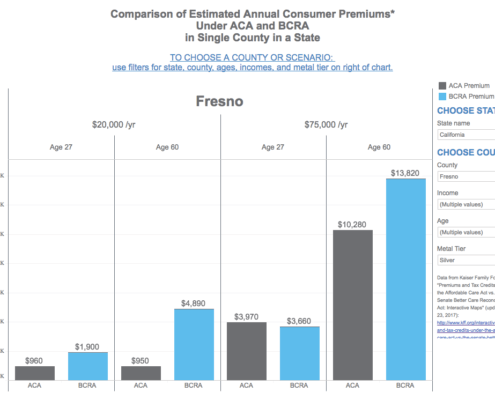
Comparison of Estimated Annual Consumer Premiums* - Under ACA and BCRA in a Low and High Cost County in the State
NASHP, in consultation with Covered California, created a 50 State data interactive that compares estimated annual consumer premiums for marketplace enrollees under the Affordable Care Act and the Better Care Reconciliation Act. Users can select and compare premiums for several ages, income levels and bronze or silver coverage. View the interactive tool here.


 For individuals living with complex, often chronic conditions, and their families, palliative care can provide relief from symptoms, improve satisfaction and outcomes, and help address critical mental and spiritual needs during difficult times. Now more than ever, there is growing recognition of the importance of palliative care services for individuals with serious illness, such as advance care planning, pain and symptom management, care coordination, and team-based, multi-disciplinary support. These services can help patients and families cope with the symptoms and stressors of disease, better anticipate and avoid crises, and reduce unnecessary and/or unwanted care. While this model is grounded in evidence that demonstrates improved quality of life, better outcomes, and reduced cost for patients, only a fraction of individuals who could benefit from palliative care receive it.
































































States’ COVID-19 Public Health Emergency Declarations and Mask Requirements
/in COVID-19 State Action Center Charts, Featured News Home, Maps COVID-19, Featured Policy Home, Health Equity, Population Health, Social Determinants of Health /by NASHP Staff and Ella RothState Approaches to Community Health Worker Financing through Medicaid State Plan Amendments
/in Community Health Workers, Policy Featured News Home, Reports Community Health Workers /by Elinor Higgins and Sandra WilknissStates Address School Vaccine Mandates and Mask Mandates
/in COVID-19 State Action Center Charts, Featured News Home, Maps Back to School, COVID-19, Featured Policy Home /by Zack Gould and Anoosha HasanApply Today to NASHP’s 2023 Emerging Leaders of Color Fellowship
/in Health Equity, Policy Blogs, Featured News Home Health Equity /by NASHP StaffHow Alaska Supports Rural and Frontier Behavioral Health Services
/in Behavioral/Mental Health and SUD, Policy Alaska Blogs, Featured News Home Behavioral/Mental Health and SUD, Community Health Workers /by Rebekah FalknerStates Use Appendix K and Emergency Waivers to Support Home- and Community-Based Services in Response to COVID-19
/in COVID-19 State Action Center Charts, Featured News Home, Maps Care Coordination, Children/Youth with Special Health Care Needs, Chronic and Complex Populations, Chronic Disease Prevention and Management, COVID-19, Health Equity, Long-Term Care, Medicaid Managed Care, Physical and Behavioral Health Integration, Population Health, Social Determinants of Health /by Salom TeshaleStrengthening Oral Health in the U.S. through Integration and Workforce Development: Lessons from State and Federal Health Officials
/in Oral Health, Policy Blogs, Featured News Home Community Health Workers /by Allie Atkeson and Megan D’AlessandroState Approaches to Contact Tracing during the COVID-19 Pandemic
/in COVID-19 State Action Center Charts, Featured News Home, Maps COVID-19, Health Equity, Population Health /by Elinor HigginsThe Future of Aging Policy: A Snapshot of State Priorities
/in Chronic and Complex Populations, Policy Blogs, Featured News Home Long-Term Care, Social Determinants of Health /by Kimberly Hodges, Wendy Fox-Grage and Hemi TewarsonState Efforts to Ban or Enforce COVID-19 Vaccine Mandates and Passports
/in COVID-19 State Action Center Featured News Home, Maps COVID-19, Featured Policy Home, Health Equity, Population Health, Relief and Recovery, Social Determinants of Health, Vaccines /by NASHP Staff and Ella Roth