
Posts
States Share Innovations to Tackle their Opioid Epidemics
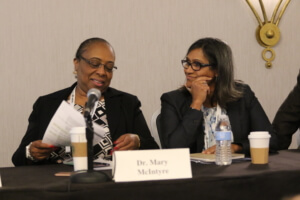
Mary McIntyre, MD, Alabama’s chief medical officer (left) and Ana Novais, executive director of Rhode Island’s Department of Health.
PORTLAND, OR – State health officials shared wide-ranging innovations in their uphill battle against the opioid epidemic that is sweeping their states at the opening day of the National Academy for State Health Policy’s (NASHP) 30th State Health Policy Conference.
Officials explained they are experimenting with new strategies that use data, new treatment approaches, and reconfigured public safety responses to illegal drug use in a race against time as overdose deaths are expected to exceed the 63,000 recorded in 2016.
Kimberly Johnson, MD, director of the US Substance Abuse and Mental Health Services Administration’s Center for Substance Abuse Treatment, ticked off the various strategies and services that are being tried out in state incubator programs that show promise in tackling this national epidemic, including providing treatment on demand, decriminalizing illegal opioid use, creating safe drug use sites and needle exchange programs, improving diagnosis of people with opioid addiction, better use of data to identify drug use patterns in communities, and addiction treatment with medications, such as methadone, which is proven to lower relapse rates.
“The number one thing states can do,” she commented following her opening remarks Monday morning, “is to address prescribing practices among providers. But it really takes all of these strategies to stop this epidemic.”
While NASHP’s three-day conference addressed a host of state public health issues, the nation’s opioid epidemic was a frequent topic at various workshops. It remains the Achilles heel, officials noted, that exposes states’ conflicting and piecemeal public health approaches even while providing opportunities for innovation.
Ana Novais, executive director of Rhode Island’s Department of Health, highlighted her state’s effort to create a dashboard that pulls data from hospitals, police, emergency rescue workers, and providers to create an overdose reporting system. Armed with data, including the latest on fentanyl deaths and locations of overdoses, the state can launch responses that involve police, rescue workers, health care providers and community leaders.
In Ohio – where one in nine of the nation’s heroin overdoses occur — the Office of Health Transformation, led by director Greg Moody, is tackling opioid over-prescribing through a health care reform called value-based pricing that rewards Medicaid managed care providers who provide high-quality care at reasonable prices.
“We wanted to knit together strategies from different domains within state government to address the opioid crisis,” he explained to more than 200 officials who attended the session. To prevent future addictions, Ohio has spearheaded a payment innovation approach to discourage over-prescribing of opioids and reward “best-practice” painkiller prescribing in its Medicaid managed care program.
One of the quality measures Ohio uses to identify “high-value” health care providers is their opioid prescribing practice. The state examines how many opioids a provider – including dentists and orthopedic specialists — prescribe and for how long. Their prescribing practices are compared with the state average. Providers who prescribe above the average amount and duration of painkillers may not get referrals and may eventually lose financial incentives.
Pennsylvania’s approach to prevent future addictions is to provide Medicaid coverage for alternative pain management treatment, such as acupuncture and yoga.
Increasing access to medically-assisted treatment for addiction, educating providers to improve opioid prescribing practices, and building coalitions between public safety and communities to get people into treatment is daunting, officials noted. Some states are proposing to add a work requirement to their Medicaid programs, similar to what exists for adults receiving Temporary Assistance to Needy Families (TANF), which concerned some policymakers. “We want to make sure that if people are working toward recovery that they are not excluded from Medicaid eligibility,” one attendee pointed out.
Another official pointed out that lawmakers in her state wondered how much funding to invest in the naloxone program if emergency personnel keep reviving the same people after multiple overdoses.
“This is a disease,” said David Kelley, MD, chief medical officer of Pennsylvania’s Department of Human Services Office of Medical Assistance Programs, “does an emergency medical technician say, ‘you’ve had angina five times already, we won’t treat you this time?’ Addiction is a disease, we need to stop thinking how many times is enough.”
“We do have to deal with the political ramifications that people still think of addiction as a personal choice,” observed Mary McIntyre, MD, chief medical officer of Alabama’s Department of Public Health.
NASHP will be publishing many of the “State Innovations and Interventions in America’s Opioid Crisis” presentations and slides, and additional blogs in the weeks ahead at oldsite.nashp.org.
Alabama
In Alabama:
- As of July 1, 2011, there were 930,736 beneficiaries enrolled in the state’s Medicaid program, 568,332 of whom were enrolled in the primary care case management program known as Patient 1st.
- Physical, behavioral, and oral health services are provided through Patient 1st and reimbursed on a fee-for-service basis. Certain Medicaid populations are excluded from this program, including dual eligibles, recipients residing in a residential or institutional facility, and recipients with developmental delays or impaired mental conditions.
- Medicaid eligible individuals ages 3 and older who would otherwise require the level of care available in an intermediate care facility for Individuals with Intellectual Disabilities (ICF/IID) can apply to receive services through two state waivers:
- Home- and Community-Based Waiver for Persons with Intellectual Disabilities, which provides residential habilitation services, including day habilitation, physical therapy, personal care, skilled nursing, and behavior management; and
- Living at Home (LAH) Waiver for Persons with Intellectual Disabilities, which includes in-home residential rehabilitation, personal care, and personal care transportation.
As of 2013, 605,305 individuals were eligible for Alabama’s Early Periodic Screening, Diagnostic and Treatment Benefit (EPSDT), known in the state as the Well Child Check-Up Program. According to 416 data from 2013, the state achieved an EPSDT screening ratio of 62% and a participant ratio of 54%. 293,440 children received dental services of any kind, with 278,533 receiving preventive dental services.
Last updated September 2014
| Medical Necessity |
The Alabama Medicaid Agency uses the federal statutory definition for medical necessity. The state requires that medical necessity be documented in a beneficiary’s medical record with supporting documentation such as: Laboratory test results, diagnostic test results, history (past attempts of management if applicable), signs and symptoms, etc. All Medicaid services are subject to retrospective review for medical necessity.
|
| Initiatives to Improve Access |
|
| Reporting & Data Collection | |
| Behavioral Health |
The Alabama ABCD Screening Academy Project worked to spread structured developmental and social emotional screening in primary health care practices. Through this project, the state expanded Medicaid reimbursement for standardized screening, and sustained and spread the use of validated, objective screening tools. More information regarding the state’s ABCD efforts can be found here.
Alabama Medicaid allows qualified providers to bill for Intensive Developmental Diagnostic Assessments (using the 96110 and 96111 CPT codes) for children under age two. These assessments are performed by multidisciplinary teams and may include both developmental screening tests and early language milestone screens (as well as interpretation and reporting of results).
|
| Support to Providers and Families |
Support for Providers:
The Alabama Medicaid Agency operates an EPSDT website which contains information for providers, including billing information, administrative code, provider agreement forms, a provider manual, and a reference sheet on periodic screenings.
The Alabama EPSDT provider manual includes information on the state’s patient education method, known as PT+3, developed to assist providers who work with illiterate or marginally literate patients and families. The method’s standardized protocol is meant to give providers the skills needed to help young or marginally literate patients remember points from a health care visit and increase knowledge and compliance. EPSDT, Patient 1st, and Medicaid family planning providers who receive training in PT+3 are eligible to receive free low literacy materials for children, teens, and adults.
Support for Families:
Alabama’s EPSDT website also contains resources for parents and families, including contact information for care coordinators, education materials, and other facts sheets.
|
| Care Coordination |
Patient 1st:
The Alabama Medicaid Agency operates the Patient 1st program, which creates a medical home for Medicaid recipients by linking them with a primary medical provider (PMP). Participating PMPs receive a monthly care management PMPM for coordinating care for Medicaid recipients in their practices. Each PMP provides and arranges for each recipient’s health care needs, and is required to provide EPSDT preventive care screenings to Medicaid eligible children. PMPs serving this population who do not provide EPSDT services are required to sign an agreement with another provider to provide EPSDT services.
Patient Care Networks
Alabama has enhanced the Patient 1st primary care case management program by creating regional Patient Care Networks. These nonprofit organizations supplement provider capacity for care coordination by assuming responsibility for “implementing a plan of care … for each [Medicaid] participant that includes coordination of care through collaboration with the member, family, primary care physicians, specialists, community resources, and pharmacists.”
A Section 2703 Health Homes state plan amendment approved in 2013 allowed Alabama to incorporate additional comprehensive care management services into the Patient Care Networks for Medicaid beneficiaries with two or more of the following conditions: asthma, diabetes, heart disease, cardiovascular disease, chronic obstructive pulmonary disease, cancer, HIV, mental health conditions, substance abuse disorder, sickle cell anemia, or organ transplant.
Alabama is currently building off of the Patient Care Network concept by planning the launch of Regional Care Organizations (RCOs). RCOs will be risk-bearing organizations that are responsible not only for providing comprehensive Medicaid benefits (including EPSDT services) and securing medical homes for all enrolled Medicaid beneficiaries in a region, but also for coordinating care across settings.
Care Coordination
The Alabama Medicaid Agency partnered with the Department of Public Health to initiate an EPSDT care coordination service for private and public providers. The program assists provider offices with identifying, contacting, coordinating, and providing follow up for children who are behind on EPSDT screenings and immunizations. Care coordinators are also available to assist with transportation services using Alabama’s Medicaid Non-Emergency Transportation (NET) program.
|
| Oral Health |
1st Look
In partnership with the Alabama Chapter of the American Academy of Pediatrics, the Alabama Academy of Pediatric Dentistry, and the Alabama Dental Association, the Alabama Medicaid Agency operates the 1st Look Program. The collaborative program is designed to reduce early childhood caries by “encouraging primary care physicians to perform dental risk assessments, provide anticipatory guidance, apply fluoride varnish when indicated, and refer children to a dental home by age one.” Children who have already seen by a dentist do not qualify for this program.
|
Realizing Rural Care Coordination: Considerations and Action Steps for State Policy-Makers
States seeking to promote better coordination of patient care, either within Medicaid or through participation in multi-payer initiatives, will run into long-standing challenges to delivering care and promoting health in rural areas. Rural areas often experience disparities in access to care, health status, and available infrastructure relative to their urban counterparts. This brief draws from health initiatives undertaken in Alabama, Colorado, Montana, New Mexico, North Carolina, and Vermont to identify common policy considerations and action steps for coordinating care in rural areas. The brief was supported by the Robert Wood Johnson Foundation’s State Health and Value Strategies.
April 2014
| Attachment | Size |
|---|---|
| Click for the Publication | 112.81 KB |
Alabama – Medical Homes
Patient Care Networks of Alabama (PCNA):
In August and September 2011, Alabama Medicaid launched three community networks as part of a new program, Patient Care Networks of Alabama, to support primary medical providers (PMPs) in becoming medical homes and delivering key services to patients. The community networks, along with a fourth added in 2012, enhanced Patient 1st, the Agency’s primary care case management (PCCM) program. Patient 1st is a statewide program operated under the authority of a 1915(b) wavier.
Among other services and functions, the Patient Care Networks of Alabama help PMPs coordinate care and teach self-management skills. The objectives of the PCNA Care Management Program are to:
-
Develop and implement patient-centered holistic plans of care;
-
Improve quality of care and quality of life;
-
Improve health literacy, health outcomes and self management;
-
Improve utilization of information technology resources by participants and providers in PCNA as available;
-
Promote the effective use of the healthcare system and community resources;
-
Reduce the potential for risks of catastrophic or severe illness;
-
Prevent disease exacerbations and complications;
-
Integrate use of evidence-based clinical practice guidelines into PCNA practices to ensure the “right care at the right time;” and
-
Reduce inappropriate utilization and costs associated with Emergency Department and hospital inpatient services.
The networks provide population health management through:
-
Systematic data analysis to target recipients and providers for outreach, education, and intervention;
-
Monitoring system access to care, services, and treatment including linkage to a medical home;
-
Monitoring and building provider capacity;
-
Monitoring quality and effectiveness of interventions to the population;
-
Supporting the medical home through education and outreach to recipients and providers; and
-
Facilitating quality improvement activities that educate, support, and monitor providers regarding evidence based care for best practice/National Standards of Care.
Networks provide care management by:
-
Advocating for high risk, high acuity recipients to ensure that recipients receive appropriate evidence based care; and
-
Educating patients about disease states and self management.
Visit the Patient 1st Handbook to learn more about that program. Further information on PCNA is available on the PCNA homepage, as well as in the original request for proposals.
Legislation passed in 2013 will build on the four existing PCNAs to form risk-bearing Regional Care Organizations (RCOs) that will manage a continuum of health care services for Medicaid beneficiaries under a single capitated rate. The RCO strategy stems from recommendations finalized in January 2013 by a multi-stakeholder Medicaid Advisory Commission that was convened by the governor in October 2012. The Alabama Medicaid Agency submitted an 1115 Waiver Concept Paper in early 2013 and has plans to work with Centers for Medicare and Medicaid Services (CMS) regarding the development of an application for a Section 1115 Demonstration Waiver.
To learn more about accountable care activity in Alabama, including Alabama’s plans to implement RCOs, visit the Alabama page of NASHP’s State Accountable Care Activity Map.
Federal Support:
-
On April 9, 2013, CMS approved a Section 2703 health home state plan amendment, creating health homes for Medicaid enrollees with a) two chronic health conditions; b) one chronic health condition and the risk of developing another; or c) one serious mental illness. Alabama’s health home program is closely aligned with the state’s Patient 1st and Patient Care Networks of Alabama programs, and implementation is limited to the four PCNA service regions. The SPA became effective as of July 1, 2012. Alabama was a recipient of a planning grant from CMS to develop its state plan amendment. To learn more about Section 2703 Health Homes, visit the CMS Health Homes webpage.
-
On May 31, 2011, the Centers for Medicare & Medicaid Services (CMS) provided the necessary 1915(b) waiver authority for the state to launch the Patient Care Networks of Alabama program in the second half of 2011.
Last Updated: April 2014
| Forming Partnerships |
Patient 1st and Patient Care Networks of Alabama (PCNA): The Alabama Medicaid Agency has established working relationships for this project with the state physician associations (including the Alabama chapters of the American Academy of Pediatrics (AAP) and American Academy of Family Physicians (AAFP)), the Alabama Primary Health Care Association (representing federally qualified health centers (FQHCs) in the state), the Department of Public Health (Children’s Health Insurance Program (CHIP) administrator), and the Department of Rehabilitation, among others. In addition, a reengaged and expanded Patient 1st Advisory Council that includes Family Voices and several physicians is guiding the Agency’s work. Alabama held town hall-style meetings with provider around the state to discuss the Patient Care Networks of Alabama (PCNA) program.
Each Patient Care Networks of Alabama network is organized as a 501(c)(3) corporation. At least one half of the board of directors for each network must be comprised of primary care physicians, and in addition the board must also include at least one representative from an FQHC, a hospital, the health department, a Regional Public Mental Health Authority, and a community pharmacist. This composition encompasses representatives from across the community to support practice transformation.
|
| Defining & Recognizing a Medical Home |
Recognition:
ACA Section 2703 Health Homes: Alabama Medicaid does not require formal recognition or certification for health home providers. Health home providers requirements are aligned with requirements for primary medical providers (PMPs) within the Patient 1st and Patient Care Networks of Alabama programs. Expectations for Patient 1st PMPs can be found in the Patient 1st Handbook.
|
| Aligning Reimbursement & Purchasing |
Patient Care Networks of Alabama (PCNA) and ACA Section 2703 Health Homes: Alabama began a staggered launch of four PCNAs beginning in August 2011, offering up to $50,000 in reimbursement for start-up costs and $3.00 PMPM for enrollees and $5.00 for enrollees who are aged, blind or disabled (ABD).
Following the implementation of the state’s health homes program in July 2012, the PCNA payment methodology moved to align with the health homes program. Separate per-member per-month payments made to the participating providers and Patient Care Networks of Alabama on behalf of health home-eligible Medicaid enrollees.
|
| Supporting Practices |
Patient Care Networks of Alabama (PCNA), and ACA Section 2703 Health Homes: Alabama has launched four patient care networks run by Patient Care Networks of Alabama (PCNA) in select counties to support primary medical providers (PMPs), with services including:
The networks are each developing initiatives around topics that have already been identified (high cost/high co-morbidity patients, asthma, diabetes, etc.) and topics that will be defined through mutual agreement.
|
|
Patient Care Networks of Alabama (PCNA): Alabama is planning to have an outside entity perform Consumer Assessment of Healthcare Providers and Systems (CAHPS) surveys for a baseline and post-implementation evaluation of change in patient experience within each community network pilot. Additionally, the state will perform a pre- and post-financial analysis. Key outcomes of interest for the community network pilots will include improved clinical outcomes, improved patient satisfaction, and Medicaid cost containment. Specific measures that will be used include CAHPS survey results, emergency department utilization for asthmatics, HbA1C measures for diabetics, inpatient hospitalization, immunization rates, and average number of office visits. The University of Southern Alabama is assisting with evaluation design. The Alabama Healthcare Improvement and Quality Alliance Workgroup—a public/private effort—is working to collectively establish measures predicated on national standards that can be used to assess progress on all programs throughout the state.
ACA Section 2703 Health Homes: Alabama has identified seven specific goals for the program:
Alabama will primarily use Medicaid claims and eligibility data to track the state’s performance specific to these goals.
|
Maximizing Enrollment Participating State Profiles
The eight states participating in the Maximizing Enrollment program aimed to simplify and streamline enrollment and renewal policies, systems and processes for Medicaid and CHIP and prepare for ACA implementation. These state profiles offer a snapshot of the states’ work within the program by highlighting the following:
- Where states started;
- Major Simplifications Implemented as a result of Maximizing Enrollment; and
- Lessons Learned
State
| Illinois | 925 KB |
| Louisiana | 2.1 MB |
| Alabama | 2 MB |
| Massachusetts | 2.1 MB |
| New York | 2.1 MB |
| Utah | 2 MB |
| Virginia | 334.2 KB |
| Wisconsin | 2.1 MB |
Aligning Federal and State Approaches to Integrating Primary Care and Community Resources
Monday, December 9, 2013
12:30-2pm EST
Join NASHP for a webinar on aligning federal and state programs and policies to support building stronger linkages between primary care and resources and services within the community, including behavioral, public health, long-term services and socio-economic supports. State leaders from Alabama and Rhode Island will describe the approaches and models being used in their states to promote the integration of primary care and community resources and the challenges and opportunities to align with federal strategies. Two federal reactors will describe opportunities for aligning federal and state approaches, including those presented by the state speakers. (Rescheduled from 10/4/13.)
Facilitator
Jill Rosenthal, Senior Program Director, National Academy for State Health Policy
State Speakers
Deidre Gifford, Medicaid Medical Director, Rhode Island Executive Office of Health and Human Services
Robert Moon, Chief Medical Officer and Deputy Commissioner, Health Systems, Alabama Medicaid
Federal Reactors
Barbara Edwards, Group Director, Center for Medicaid and CHIP Services, Centers for Medicare & Medicaid Services
Suzanne Fields, Senior Advisor to the Administrator on Health Care Financing, Substance Abuse and Mental Health Services Administration
Alabama
In Alabama:
- As of July 1, 2011, there were 930,736 beneficiaries enrolled in the state’s Medicaid program, 568,332 of whom were enrolled in the primary care case management program known as Patient 1st.
- Physical, behavioral, and oral health services are provided through Patient 1st and reimbursed on a fee-for-service basis. Certain Medicaid populations are excluded from this program, including dual eligibles, recipients residing in a residential or institutional facility, and recipients with developmental delays or impaired mental conditions.
- Medicaid eligible individuals ages 3 and older who would otherwise require the level of care available in an intermediate care facility for Individuals with Intellectual Disabilities (ICF/IID) can apply to receive services through two state waivers:
- Home- and Community-Based Waiver for Persons with Intellectual Disabilities, which provides residential habilitation services, including day habilitation, physical therapy, personal care, skilled nursing, and behavior management; and
- Living at Home (LAH) Waiver for Persons with Intellectual Disabilities, which includes in-home residential rehabilitation, personal care, and personal care transportation.
As of 2013, 605,305 individuals were eligible for Alabama’s Early Periodic Screening, Diagnostic and Treatment Benefit (EPSDT), known in the state as the Well Child Check-Up Program. According to 416 data from 2013, the state achieved an EPSDT screening ratio of 62% and a participant ratio of 54%. 293,440 children received dental services of any kind, with 278,533 receiving preventive dental services.
Last updated September 2014
| Medical Necessity |
The Alabama Medicaid Agency uses the federal statutory definition for medical necessity. The state requires that medical necessity be documented in a beneficiary’s medical record with supporting documentation such as: Laboratory test results, diagnostic test results, history (past attempts of management if applicable), signs and symptoms, etc. All Medicaid services are subject to retrospective review for medical necessity.
|
| Initiatives to Improve Access |
|
| Reporting & Data Collection | |
| Behavioral Health |
The Alabama ABCD Screening Academy Project worked to spread structured developmental and social emotional screening in primary health care practices. Through this project, the state expanded Medicaid reimbursement for standardized screening, and sustained and spread the use of validated, objective screening tools. More information regarding the state’s ABCD efforts can be found here.
Alabama Medicaid allows qualified providers to bill for Intensive Developmental Diagnostic Assessments (using the 96110 and 96111 CPT codes) for children under age two. These assessments are performed by multidisciplinary teams and may include both developmental screening tests and early language milestone screens (as well as interpretation and reporting of results).
|
| Support to Providers and Families |
Support for Providers:
The Alabama Medicaid Agency operates an EPSDT website which contains information for providers, including billing information, administrative code, provider agreement forms, a provider manual, and a reference sheet on periodic screenings.
The Alabama EPSDT provider manual includes information on the state’s patient education method, known as PT+3, developed to assist providers who work with illiterate or marginally literate patients and families. The method’s standardized protocol is meant to give providers the skills needed to help young or marginally literate patients remember points from a health care visit and increase knowledge and compliance. EPSDT, Patient 1st, and Medicaid family planning providers who receive training in PT+3 are eligible to receive free low literacy materials for children, teens, and adults.
Support for Families:
Alabama’s EPSDT website also contains resources for parents and families, including contact information for care coordinators, education materials, and other facts sheets.
|
| Care Coordination |
Patient 1st:
The Alabama Medicaid Agency operates the Patient 1st program, which creates a medical home for Medicaid recipients by linking them with a primary medical provider (PMP). Participating PMPs receive a monthly care management PMPM for coordinating care for Medicaid recipients in their practices. Each PMP provides and arranges for each recipient’s health care needs, and is required to provide EPSDT preventive care screenings to Medicaid eligible children. PMPs serving this population who do not provide EPSDT services are required to sign an agreement with another provider to provide EPSDT services.
Patient Care Networks
Alabama has enhanced the Patient 1st primary care case management program by creating regional Patient Care Networks. These nonprofit organizations supplement provider capacity for care coordination by assuming responsibility for “implementing a plan of care … for each [Medicaid] participant that includes coordination of care through collaboration with the member, family, primary care physicians, specialists, community resources, and pharmacists.”
A Section 2703 Health Homes state plan amendment approved in 2013 allowed Alabama to incorporate additional comprehensive care management services into the Patient Care Networks for Medicaid beneficiaries with two or more of the following conditions: asthma, diabetes, heart disease, cardiovascular disease, chronic obstructive pulmonary disease, cancer, HIV, mental health conditions, substance abuse disorder, sickle cell anemia, or organ transplant.
Alabama is currently building off of the Patient Care Network concept by planning the launch of Regional Care Organizations (RCOs). RCOs will be risk-bearing organizations that are responsible not only for providing comprehensive Medicaid benefits (including EPSDT services) and securing medical homes for all enrolled Medicaid beneficiaries in a region, but also for coordinating care across settings.
Care Coordination
The Alabama Medicaid Agency partnered with the Department of Public Health to initiate an EPSDT care coordination service for private and public providers. The program assists provider offices with identifying, contacting, coordinating, and providing follow up for children who are behind on EPSDT screenings and immunizations. Care coordinators are also available to assist with transportation services using Alabama’s Medicaid Non-Emergency Transportation (NET) program.
|
| Oral Health |
1st Look
In partnership with the Alabama Chapter of the American Academy of Pediatrics, the Alabama Academy of Pediatric Dentistry, and the Alabama Dental Association, the Alabama Medicaid Agency operates the 1st Look Program. The collaborative program is designed to reduce early childhood caries by “encouraging primary care physicians to perform dental risk assessments, provide anticipatory guidance, apply fluoride varnish when indicated, and refer children to a dental home by age one.” Children who have already seen by a dentist do not qualify for this program.
|
Federal and State Policy to Promote the Integration of Primary Care and Community Resources
Around the country, models are emerging to link primary care providers not only to other medical service providers but also to resources and services in the community. This report—the first in a series supported by The Commonwealth Fund to explore opportunities for improvement in federal and state policy–highlights relevant policy levers and federal and state initiatives to integrate these resources. It also discusses opportunities for policy improvement identified during a Commonwealth Fund-supported discourse among high-level state and federal officials hosted by NASHP.
August 2013
| Attachment | Size |
|---|---|
| Click for the Publication | 249.18 KB |
Care Management for Medicaid Enrollees Through Community Health Teams
The effective management of patients’ complex illnesses across providers, settings, and systems places extraordinary demands on primary care providers, especially those that work in resource-limited small or rural practices. Medicaid programs in some states have adopted strategies to build practice capacity to care for high-need Medicaid beneficiaries through the development of local community health teams, with members in fields such as nursing, behavioral health, pharmacy, and social work. Using data from a 2011–2012 review of state Medicaid medical home programs, we identified community health team programs in eight states that provide an array of targeted services, from care coordination to self-management coaching.
| Click here for the publication. | 998.1 KB |
 For individuals living with complex, often chronic conditions, and their families, palliative care can provide relief from symptoms, improve satisfaction and outcomes, and help address critical mental and spiritual needs during difficult times. Now more than ever, there is growing recognition of the importance of palliative care services for individuals with serious illness, such as advance care planning, pain and symptom management, care coordination, and team-based, multi-disciplinary support. These services can help patients and families cope with the symptoms and stressors of disease, better anticipate and avoid crises, and reduce unnecessary and/or unwanted care. While this model is grounded in evidence that demonstrates improved quality of life, better outcomes, and reduced cost for patients, only a fraction of individuals who could benefit from palliative care receive it.
































































