
Posts
Eight States Join NASHP’s Maternal and Child Health Policy Innovation Program Policy Academy to Address Maternal Mortality
The National Academy for State Health Policy (NASHP) has announced a new, two-year policy academy kicking off in April for state health officials interested in building state capacity to address maternal mortality for Medicaid-eligible pregnant and parenting women, with the goal of improving access to quality care.
Through the Maternal and Child Health Policy Innovation Program (MCH PIP), funded by the Maternal and Child Health Bureau within the Health Resources and Services Administration, NASHP’s Maternal and Child Health Policy Innovation Program Policy Academy will engage eight state teams (GA, ID, IL, IA, LA, PA, SD, and VA). The teams include representatives from state Medicaid agencies, public health agencies, and other state stakeholders (e.g., mental health/substance use agencies, child welfare agencies, provider groups, Medicaid managed care plans, and others.)
Through this policy academy, states will identify, develop, and implement policy changes or develop specific plans for policy changes to improve maternal health outcomes, with a specific focus on improving racial disparities in maternal mortality.
The United States has seen a steady rise in maternal mortality over the past few years and has the worst maternal mortality rate among developed nations. Additionally, there are stark racial disparities in pregnancy-related deaths. American Indian/Alaska Native and Black women are two- to three- times more likely to die from pregnancy-related causes than non-Latinx (non-Hispanic) White women. States are grappling with a number of factors in their efforts to improve access to quality care for this population and strengthen the systems serving them.
Over the course of the two-year project, NASHP will provide technical assistance to states, identify barriers, and share promising practices for improving maternal health outcomes to help states achieve their policy goals.
NASHP Roundtable: Georgia and Illinois Work to Improve Maternal Health Outcomes
In partnership with the Blue Cross Blue Shield Association, the National Academy for State Health Policy (NASHP) recently held a virtual roundtable discussion of state officials to discuss maternal health initiatives in Illinois and Georgia and explore strategies to improve maternal health outcomes for Medicaid enrollees.
Despite spending more than other developed nations on hospital-provided maternity care, about 700 US women die each year from pregnancy-related complications.
- Women of color have significantly higher rates of maternal morbidity and mortality, and Black women are approximately four-times more likely than White women to die of pregnancy-related causes.
- In comparison to women covered by private insurance, pregnant women enrolled in Medicaid have increased rates of severe maternal morbidity and mortality and are more likely to have risk factors affecting their pregnancies.
One approach proposed by a number of states is extending Medicaid postpartum coverage for women beyond the current 60-day period. As highlighted in NASHP’s interactive map and chart, Each State’s Efforts to Extend Medicaid Coverage to Postpartum Women, 23 states and Washington, DC have initiated efforts to extend postpartum coverage, and currently four states are in the process of seeking federal approval to do so through a Section 1115 demonstration waiver.
Georgia’s Extension of Postpartum Coverage
Georgia is one of those states and the state’s Medicaid director explained during the discussion that they are planning to submit a waiver proposal to the Centers for Medicare & Medicaid Services in December to extend postpartum coverage there. The state’s efforts began in 2010 when Georgia was ranked 50th in the nation for maternal mortality rates. Officials first formed an advisory committee to focus on the issue. As they examined specific maternal mortality data and rates, Georgia found that close to 60 percent of the maternal deaths were actually preventable. In 2019, the Georgia House passed a resolution to create a committee to study maternal mortality, which led directly to the state’s current efforts to pursue an extension of postpartum Medicaid coverage.
While Georgia’s study committee initially suggested extending postpartum coverage for 12 months, due to budget constraints the state was unable to pursue that recommendation. Instead, the state opted to seek extended coverage for individuals with income up to 225 percent of the federal poverty level for four months, which when added to Medicaid’s 60-day postpartum coverage period, will provide a total of six months (180 days) of coverage postpartum. Overall, the state legislature allocated $59 million for the proposed five-year demonstration project.
Services under the extended postpartum coverage will be provided through managed care, and after Medicaid’s 60-day postpartum period, individuals will be seamlessly transferred to coverage under the waiver. During the first year, the state anticipates that there will be approximately 151,000 enrollees, and it is expected that enrollment will grow to about 186,000 by the final year of the demonstration.
Blue Cross Blue Shield of Illinois Pilot Program
The discussion also featured maternal and child health improvement initiatives in Medicaid that Blue Cross Blue Shield of Illinois (BCBSIL) is currently pursuing. BCBSIL is conducting a 12-month, multi-pronged pilot program in partnership with community organizations and medical providers that is designed to address factors that negatively impact health outcomes in the maternal and child population. The goals of the pilot program are to reduce the number of elective, non-medically necessary Caesarian sections (C-sections) and newborn intensive care unit (NICU) admissions, as well as improve Healthcare Effectiveness Data and Information Set (HEDIS) rates in both prenatal visits and child immunizations.
Under the pilot program’s first goal of reducing unnecessary C-sections, BCBSIL plans to enhance care coordination efforts between providers, Medicaid agencies, and community organizations. As part of its second goal to improve prenatal and postpartum care visit rates, BCBSIL will target efforts in areas of Illinois with high rates of maternal and child health disparities. Within these regions, BCBSIL will identify at least three obstetrics practices that are willing to partner with BCBSIL. These providers will be connected with BCBS care coordinators to help ensure access to care delivery resources, because often providers lack the capacity to provide social service referrals for their members. BCBS enrollees will also have the opportunity to engage in an incentive program that will offer rewards for completion of prenatal care visits.
In addition to promoting better maternal health outcomes, the BCBSIL pilot program is also working to improve pediatric immunization and dental care rates. Through partnerships with Chicago public schools and community organizations, the pilot program will disseminate information about the importance of immunizations and preventive dental care and also create a referral system for children in need of these services and other preventive health care. The planning phases of the pilot program began this fall, and the initiative will continue through the end of 2021.
Along with tracking states’ initiatives to expand postpartum Medicaid coverage, NASHP has a wide range of resources related to maternal health and healthy child development, and will be continuing to follow states’ efforts to improve maternal and child health outcomes.
The online meeting and this blog were sponsored by Blue Cross Blue Shield Association,
with content development at the sole discretion of NASHP. To view a slide deck highlighting materials from the online meeting, please click here.
States Share Innovations to Tackle their Opioid Epidemics
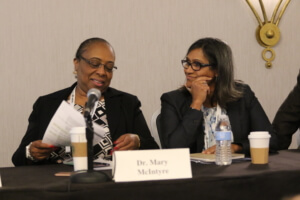
Mary McIntyre, MD, Alabama’s chief medical officer (left) and Ana Novais, executive director of Rhode Island’s Department of Health.
PORTLAND, OR – State health officials shared wide-ranging innovations in their uphill battle against the opioid epidemic that is sweeping their states at the opening day of the National Academy for State Health Policy’s (NASHP) 30th State Health Policy Conference.
Officials explained they are experimenting with new strategies that use data, new treatment approaches, and reconfigured public safety responses to illegal drug use in a race against time as overdose deaths are expected to exceed the 63,000 recorded in 2016.
Kimberly Johnson, MD, director of the US Substance Abuse and Mental Health Services Administration’s Center for Substance Abuse Treatment, ticked off the various strategies and services that are being tried out in state incubator programs that show promise in tackling this national epidemic, including providing treatment on demand, decriminalizing illegal opioid use, creating safe drug use sites and needle exchange programs, improving diagnosis of people with opioid addiction, better use of data to identify drug use patterns in communities, and addiction treatment with medications, such as methadone, which is proven to lower relapse rates.
“The number one thing states can do,” she commented following her opening remarks Monday morning, “is to address prescribing practices among providers. But it really takes all of these strategies to stop this epidemic.”
While NASHP’s three-day conference addressed a host of state public health issues, the nation’s opioid epidemic was a frequent topic at various workshops. It remains the Achilles heel, officials noted, that exposes states’ conflicting and piecemeal public health approaches even while providing opportunities for innovation.
Ana Novais, executive director of Rhode Island’s Department of Health, highlighted her state’s effort to create a dashboard that pulls data from hospitals, police, emergency rescue workers, and providers to create an overdose reporting system. Armed with data, including the latest on fentanyl deaths and locations of overdoses, the state can launch responses that involve police, rescue workers, health care providers and community leaders.
In Ohio – where one in nine of the nation’s heroin overdoses occur — the Office of Health Transformation, led by director Greg Moody, is tackling opioid over-prescribing through a health care reform called value-based pricing that rewards Medicaid managed care providers who provide high-quality care at reasonable prices.
“We wanted to knit together strategies from different domains within state government to address the opioid crisis,” he explained to more than 200 officials who attended the session. To prevent future addictions, Ohio has spearheaded a payment innovation approach to discourage over-prescribing of opioids and reward “best-practice” painkiller prescribing in its Medicaid managed care program.
One of the quality measures Ohio uses to identify “high-value” health care providers is their opioid prescribing practice. The state examines how many opioids a provider – including dentists and orthopedic specialists — prescribe and for how long. Their prescribing practices are compared with the state average. Providers who prescribe above the average amount and duration of painkillers may not get referrals and may eventually lose financial incentives.
Pennsylvania’s approach to prevent future addictions is to provide Medicaid coverage for alternative pain management treatment, such as acupuncture and yoga.
Increasing access to medically-assisted treatment for addiction, educating providers to improve opioid prescribing practices, and building coalitions between public safety and communities to get people into treatment is daunting, officials noted. Some states are proposing to add a work requirement to their Medicaid programs, similar to what exists for adults receiving Temporary Assistance to Needy Families (TANF), which concerned some policymakers. “We want to make sure that if people are working toward recovery that they are not excluded from Medicaid eligibility,” one attendee pointed out.
Another official pointed out that lawmakers in her state wondered how much funding to invest in the naloxone program if emergency personnel keep reviving the same people after multiple overdoses.
“This is a disease,” said David Kelley, MD, chief medical officer of Pennsylvania’s Department of Human Services Office of Medical Assistance Programs, “does an emergency medical technician say, ‘you’ve had angina five times already, we won’t treat you this time?’ Addiction is a disease, we need to stop thinking how many times is enough.”
“We do have to deal with the political ramifications that people still think of addiction as a personal choice,” observed Mary McIntyre, MD, chief medical officer of Alabama’s Department of Public Health.
NASHP will be publishing many of the “State Innovations and Interventions in America’s Opioid Crisis” presentations and slides, and additional blogs in the weeks ahead at oldsite.nashp.org.
 For individuals living with complex, often chronic conditions, and their families, palliative care can provide relief from symptoms, improve satisfaction and outcomes, and help address critical mental and spiritual needs during difficult times. Now more than ever, there is growing recognition of the importance of palliative care services for individuals with serious illness, such as advance care planning, pain and symptom management, care coordination, and team-based, multi-disciplinary support. These services can help patients and families cope with the symptoms and stressors of disease, better anticipate and avoid crises, and reduce unnecessary and/or unwanted care. While this model is grounded in evidence that demonstrates improved quality of life, better outcomes, and reduced cost for patients, only a fraction of individuals who could benefit from palliative care receive it.
































































