
Posts
Harm Reduction in the COVID-19 Era: States Respond with Innovations
Despite COVID-19 workarounds, such as telehealth and virtual recovery programs enabled by flexible federal guidelines, more than 40 states have reported increases in drug overdoses during the pandemic, underscoring the importance of keeping state harm reduction programs as accessible as possible.
As COVID-19 upends the nation’s health care systems, treatment for substance use disorder (SUD) has shifted to telehealth environments and recovery programs have gone virtual as state and federal policymakers adjust regulations and guidance to maintain access to services. But the unique risks facing people with SUD during this time of isolation and mandatory social distancing are also becoming more clear.
State-authorized harm reduction programs that provide syringe exchange services, testing for infectious diseases and referral to treatment, and connections to treatment for opioid use disorder and other SUDs provide a critical intervention. Despite the challenges of implementing COVID-19 protocols for what have traditionally been in-person services, states have developed flexibilities and innovative approaches to ensuring that these programs continue to provide critical, ongoing support to people with SUD until they are ready for treatment.
State guidance for harm reduction providers in response to COVID-19:
The guidance that state officials and agencies have developed recognize the unique challenges that face harm reduction providers during the COVID-19 pandemic. Many states acknowledge harm reduction as an essential service and some have temporarily loosened program restrictions to ensure the continuity of services during the pandemic.
- The Oregon Health Authority (OHA) authorized its Syringe Service Programs (SSP) to provide curbside services and phone orders for syringes, naloxone, and other supplies. OHA also suggested operational shifts in staffing, distancing protocols, and volunteer management to mitigate COVID-19 transmission among staff, volunteers, and clients. OHA included messaging in support of people who use drugs (PWUD) in order to maintain their safety during the pandemic. The messaging emphasized the increased respiratory risks associated with drug use and COVID-19 and provided guidance on how to reduce the risk of COVID-19 infection as well as the risk of overdose during the pandemic.
- In Maine, Gov. Janet Mills issued an Executive Order on March 30, 2020, suspending an existing one-to-one syringe exchange rule, thereby increasing the number of syringes individuals can take home at once. The order also allows flexibility in mail delivery services, needle exchange site locations and operational hours and provided on-site social distancing protocols.
- The Missouri Department of Mental Health issued comprehensive COVID-19 guidance in mid-March, which featured published resources from the Substance Abuse and Mental Health Services Administration (SAMHSA), the Harm Reduction Coalition, and the National Health Care for the Homeless Council (NHCHC), as well as best practices from other states and programs. Missouri’s guidance includes operational directives for treatment and harm reduction providers, as well as practical harm reduction guidance for PWUD, particularly individuals who use drugs alone.
Adaptations in harm reduction services:
Harm reduction programs are making policy shifts to develop practices that respond to the specific needs of their communities. As states and municipalities have responded to the COVID-19 pandemic at varying degrees of restrictiveness, harm reduction programs have also tailored their programs to respond to the pandemic.
- Operational changes. Programs in Washington and other states have shifted services outdoors. They now provide curbside or mobile services and have closed their fixed sites entirely and instead rely on delivery services. Many Washington State SSP programs have limited hours and scope of services. In New York, SSPs have been operating with skeletal staff and reduced resources. In response to the new limitations on in-person service, 22 of 23 of New York’s SSPs now rely on some form of peer-delivered syringe services.
- Shifts in testing priorities. In addition to continuing to provide harm reduction services, some SSPs in Washington now provide COVID-19 screening and testing at their program sites. West Virginia’s harm reduction programs have reduced the amount of non-COVID-19 infectious disease testing they’re conducting and the amount of hepatitis A and B immunizations they administer, in order to focus on COVID-19 and the immediate needs of individuals with SUD.
- Emphasizing naloxone distribution. As overdose rates continue to rise during the pandemic, states are increasing access to the overdose-reversal drug naloxone. Pennsylvania’s Secretary of Health signed an updated standing order that allows community organizations to distribute naloxone through mail. Ohio’s Department of Mental Health and Addiction Services has provided official guidance to all community programs through its statewide Project DAWN overdose reversal initiative to maintain minimal contact with individuals who need services while maximizing naloxone distribution as a strategy to mitigate overdoses. Additionally, the US Department of Health and Human Services has published guidance for first responders to safely administer naloxone during the pandemic.
Looking Ahead
As states begin to consider the impact of COVID-19 on their budgets, programming, and future planning, maintaining harm reduction programs may become more challenging. Harm reduction programs are often supported by multiple funding streams, and program administrators and policymakers may consider leveraging federal grants and other non-state funds to maintain these services. In addition to ensuring access to infectious disease prevention and life-saving treatment and recovery services, harm reduction programs offer a mechanism to maintain engagement with people who have SUD and reduce their risk of overdose, which results from isolation.
This work was funded by the Foundation for Opioid Response Efforts (FORE). The views and conclusions contained in this document are those of the authors and should not be interpreted as representing the official policies or stance, either expressed or implied, of FORE. FORE is authorized to reproduce and distribute reprints for foundation purposes notwithstanding any copyright notation hereon.
Q&A: To Shape an Effective Response to the Opioid Crisis in Texas, You Need to Ask ‘Will It Work in Odessa?’

Karen Palombo
Karen Palombo is the substance use disorder (SUD) team lead in the Texas Health and Human Services Commission’s mental health and substance use division who helps shape state intervention and treatment policies. Before joining state government, she worked in hospital, mental health, and SUD treatment settings for nine years as a licensed chemical dependency counselor. Her first-hand knowledge of SUD treatment challenges in a state with an expansive mix of rural and urban gives her a unique perspective into how a state policymaker can use data, relationships, and grassroots connections to design and promote effective programs.
How did you come to work in SUD treatment in direct care, and then at a state policy level?
During my undergraduate and graduate years, I worked at a short-term residential treatment center for kids removed from their parents. About 80 percent were over age 12 and they talked a lot about seeing their parents drunk and high all the time. They were often prescribed depression and anxiety medications, but what they were really dealing with was trauma. They talked about how when they became parents they would do things differently.
My next job was in child protective services, where I worked with grown-up versions of those same traumatized kids, who still didn’t have the skills to do things differently. They had limited support, a mistrust of government resources, inappropriate social skills, and none or few coping skills. I wanted to work on a policy level to address that.
How did you come to focus on women and children?
I thought if I could keep women and children together during recovery, it would have the most impact. When women and kids don’t stay together, we know kids are safe, but are they secure? Unfortunately, children going through the child welfare system learn not to trust adults because if they tell them about their parents’ relapse and abuse, their family is separated and they are removed. My goal is for health care providers to have the community resources they need available so they know who to call and how to respond when a pregnant woman with SUD walks in the door to make sure her whole family is treated.
Like many rural states, Texas has inconsistent state data on opioid overdose deaths. As a policymaker, how do you make the case for more targeted resources to improve opioid prevention and treatment when data is unreliable?
In some areas, we have very good data, for example, we’re one of only two states that track if alcohol and other substances were involved — even if it was not the direct reason for a child’s removal. When we don’t have data, we rely on relationships with the people on the ground who know the things we need to know. I make tours around the state all the time and have the luxury of sitting on lots of committees where I’m always making the case for data collection. If I’m talking to a hospital, I know to talk about poison control, emergency department data, and hospital costs. It makes us better data collectors and sharers, but it’s done on a regional basis and relies on relationships.
I also know that when I call our Medicaid office and say, ‘I’m trying to find out how long newborns with neonatal abstinence syndrome stay in NICUs at the hospitals where I have given a community presentation,’ my contact knows what code to use and she can tell me from her data indicators what is happening on a statewide basis vs. on a regional basis. When individual staff persons see why they collect the data they do — when they see it in a report — it starts to matter.
Is regional information critical in order to fine-tune program design in such a large state?
When you work in a state the size of Texas, with its diverse rural and urban populations, knowing what’s happening on a regional level is critical. The types of [illegal] drugs used vary between regions. In some areas, opioids never really arrived and cocaine never left. From a public health perspective, we need programs that work no matter what drug is used. When I’m talking to officials in Odessa, they don’t care about a statewide picture, they only care about what will work in Odessa.
Your state legislature meets every two years, how do you get the resources you need to redesign or launch programs for a rapid response to this epidemic?
As part of legislative recommendations, Behavioral Health Services division moved from the Department of State Health Services to the Health and Human Services Commission, which has led to better collaboration and communication to address behavioral health alongside primary health. We have been able to reconfigure our programs, and now have a foothold so our workgroups now touch all of these government programs that affect women. For instance, Texas Medicaid now reimburses for SBIRT [Screening, Brief Intervention, and Referral to Treatment] and postpartum depression screenings. We were able to assist in writing language about the Medicaid benefit, which screenings would be reimbursable, and suggested at one meeting that it would be important at well-child visits to be able to screen for postpartum depression. This is now a benefit in Texas. We probably would not have been involved in this process if not for the state agency re-organization.
How are you breaking down traditional siloes that impede a collaborative response to this crisis?
I have attended monthly workgroup meetings for four years waiting for someone to turn to me and say, ‘don’t you do that?’ If we’re not there to share what we do and learn how to collaborate, nothing happens. Our team members work with child welfare, public health, maternal child health, community health workers, train-the-trainer programs in local communities, homelessness, housing, and recovery programs, education departments, and workforce development. Serving on those committees makes us better data collectors and sharers. Data is everything, you never know what the scope of a problem is until you identify the data you need.
Can you give me an example of how has data collection has resulted in better state policy?
At our workgroups, we started hearing anecdotal information about women with SUD miscarrying in jails. [Pregnant women are at high risk of miscarriage if they go into withdrawal and do not receive medication-assisted treatment (MAT), such as methadone.]
The Texas legislature instructed the Texas Commission on Jail Standards to collect data on miscarriages starting in 2016. When data collection began, we started to get more calls from jail nursing staff asking how to get methadone to pregnant women. The data collection led to awareness and to development of new policies to address the problem. Most jails that have nearby methadone clinics are developing standard protocol for when [incarcerated] pregnant women report opioid use disorder.
We’re also collecting data for the MOM – Maternal Opiate Mortality study. We know opioid overdose is the leading cause of death for women after childbirth in Texas. We’re looking at what happens that made women relapse, we’re interviewing these women and their families, and identifying how the state can make sure women who leave Medicaid after childbirth continue to receive MAT. In 2020, we’ll use the findings to develop guidelines for providers to screen more high-risk women and work to reduce maternal deaths.
What would you recommend to other states that are working to develop more effective SUD programs?
What I’ve learned is you never stop going back into communities and asking them what they want and need. When you work at a state level, you often stop doing community outreach, asking questions, or attending forums. If people in the community don’t agree with what you’re trying to do on a state level, it’s not going to work.
The biggest issue for us is getting treatment to rural areas. Communities with more people have more money and more access to health care. Rural communities will tell you they know that people don’t care about them. That’s hard to hear when you’re sitting in a room listening to them, but as a state official, you really need to know what’s going on if you’re going to develop effective policies.
States Share Innovations to Tackle their Opioid Epidemics
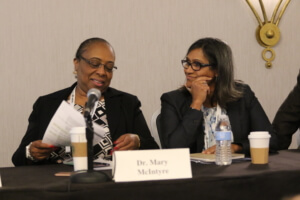
Mary McIntyre, MD, Alabama’s chief medical officer (left) and Ana Novais, executive director of Rhode Island’s Department of Health.
PORTLAND, OR – State health officials shared wide-ranging innovations in their uphill battle against the opioid epidemic that is sweeping their states at the opening day of the National Academy for State Health Policy’s (NASHP) 30th State Health Policy Conference.
Officials explained they are experimenting with new strategies that use data, new treatment approaches, and reconfigured public safety responses to illegal drug use in a race against time as overdose deaths are expected to exceed the 63,000 recorded in 2016.
Kimberly Johnson, MD, director of the US Substance Abuse and Mental Health Services Administration’s Center for Substance Abuse Treatment, ticked off the various strategies and services that are being tried out in state incubator programs that show promise in tackling this national epidemic, including providing treatment on demand, decriminalizing illegal opioid use, creating safe drug use sites and needle exchange programs, improving diagnosis of people with opioid addiction, better use of data to identify drug use patterns in communities, and addiction treatment with medications, such as methadone, which is proven to lower relapse rates.
“The number one thing states can do,” she commented following her opening remarks Monday morning, “is to address prescribing practices among providers. But it really takes all of these strategies to stop this epidemic.”
While NASHP’s three-day conference addressed a host of state public health issues, the nation’s opioid epidemic was a frequent topic at various workshops. It remains the Achilles heel, officials noted, that exposes states’ conflicting and piecemeal public health approaches even while providing opportunities for innovation.
Ana Novais, executive director of Rhode Island’s Department of Health, highlighted her state’s effort to create a dashboard that pulls data from hospitals, police, emergency rescue workers, and providers to create an overdose reporting system. Armed with data, including the latest on fentanyl deaths and locations of overdoses, the state can launch responses that involve police, rescue workers, health care providers and community leaders.
In Ohio – where one in nine of the nation’s heroin overdoses occur — the Office of Health Transformation, led by director Greg Moody, is tackling opioid over-prescribing through a health care reform called value-based pricing that rewards Medicaid managed care providers who provide high-quality care at reasonable prices.
“We wanted to knit together strategies from different domains within state government to address the opioid crisis,” he explained to more than 200 officials who attended the session. To prevent future addictions, Ohio has spearheaded a payment innovation approach to discourage over-prescribing of opioids and reward “best-practice” painkiller prescribing in its Medicaid managed care program.
One of the quality measures Ohio uses to identify “high-value” health care providers is their opioid prescribing practice. The state examines how many opioids a provider – including dentists and orthopedic specialists — prescribe and for how long. Their prescribing practices are compared with the state average. Providers who prescribe above the average amount and duration of painkillers may not get referrals and may eventually lose financial incentives.
Pennsylvania’s approach to prevent future addictions is to provide Medicaid coverage for alternative pain management treatment, such as acupuncture and yoga.
Increasing access to medically-assisted treatment for addiction, educating providers to improve opioid prescribing practices, and building coalitions between public safety and communities to get people into treatment is daunting, officials noted. Some states are proposing to add a work requirement to their Medicaid programs, similar to what exists for adults receiving Temporary Assistance to Needy Families (TANF), which concerned some policymakers. “We want to make sure that if people are working toward recovery that they are not excluded from Medicaid eligibility,” one attendee pointed out.
Another official pointed out that lawmakers in her state wondered how much funding to invest in the naloxone program if emergency personnel keep reviving the same people after multiple overdoses.
“This is a disease,” said David Kelley, MD, chief medical officer of Pennsylvania’s Department of Human Services Office of Medical Assistance Programs, “does an emergency medical technician say, ‘you’ve had angina five times already, we won’t treat you this time?’ Addiction is a disease, we need to stop thinking how many times is enough.”
“We do have to deal with the political ramifications that people still think of addiction as a personal choice,” observed Mary McIntyre, MD, chief medical officer of Alabama’s Department of Public Health.
NASHP will be publishing many of the “State Innovations and Interventions in America’s Opioid Crisis” presentations and slides, and additional blogs in the weeks ahead at oldsite.nashp.org.
 For individuals living with complex, often chronic conditions, and their families, palliative care can provide relief from symptoms, improve satisfaction and outcomes, and help address critical mental and spiritual needs during difficult times. Now more than ever, there is growing recognition of the importance of palliative care services for individuals with serious illness, such as advance care planning, pain and symptom management, care coordination, and team-based, multi-disciplinary support. These services can help patients and families cope with the symptoms and stressors of disease, better anticipate and avoid crises, and reduce unnecessary and/or unwanted care. While this model is grounded in evidence that demonstrates improved quality of life, better outcomes, and reduced cost for patients, only a fraction of individuals who could benefit from palliative care receive it.
































































