
Medicaid Adult Dental Coverage
Medicaid and CHIP programs are required to offer children’s dental benefits, but coverage of adult dental services is optional for state Medicaid programs. While adult dental coverage is frequently reduced or eliminated when states are faced with fiscal pressures, several states have revisited those decisions. Ensuring coverage for adult dental services in Medicaid can provide a foundation from which to take advantage of potential cost-savings from reducing avoidable emergency department visits and leveraging connections between oral health and overall health. In this section of the toolkit, you will find resources and policy briefs related to Medicaid adult dental coverage. In coming months, new resources will be added to this section, including a brief and case studies that will explore how seven states added, enhanced, or reinstated Medicaid adult dental coverage between 2013 and 2015.
The following resources may be useful to states exploring options for adult dental coverage in Medicaid:
- Advancing Dental Access, Innovation, and Quality for Adult Medicaid Beneficiaries (Center for Health Care Strategies)
- Increasing Access to Dental Care in Medicaid: Targeted Programs for Four Populations (NASHP)
- How Do Providers Respond to Public Health Insurance Expansions? Evidence from Adult Medicaid Dental Benefits (National Bureau of Economic Research working paper)
- Medicaid Market for Dental Care Poised for Major Growth in Many States (American Dental Association Health Policy Institute)
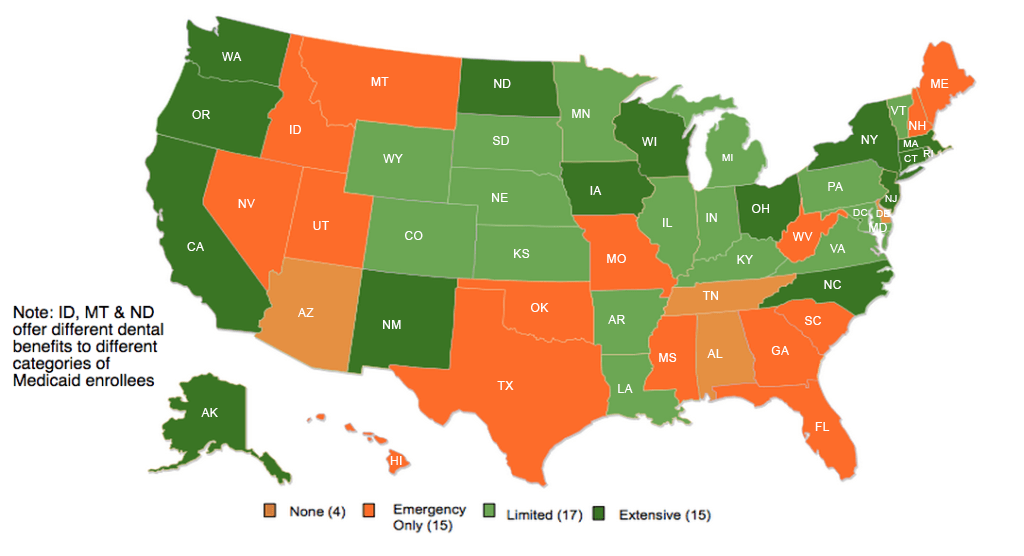
Adult Medicaid dental benefits vary widely by state.*

* Source: Center for Health Care Strategies, “Medicaid Adult Dental Benefits: An Overview” (2015). https://www.chcs.org/media/Adult-Oral-Health-Fact-Sheet_21915.pdf.
Emergency Only: Relief of pain under emergency situations.
Limited: Fewer than 100 dental procedures covered; annual benefit cap of less than $1,000.
Extensive: More than 100 dental procedures covered; annual benefit cap of $1,000 or more.



 For individuals living with complex, often chronic conditions, and their families, palliative care can provide relief from symptoms, improve satisfaction and outcomes, and help address critical mental and spiritual needs during difficult times. Now more than ever, there is growing recognition of the importance of palliative care services for individuals with serious illness, such as advance care planning, pain and symptom management, care coordination, and team-based, multi-disciplinary support. These services can help patients and families cope with the symptoms and stressors of disease, better anticipate and avoid crises, and reduce unnecessary and/or unwanted care. While this model is grounded in evidence that demonstrates improved quality of life, better outcomes, and reduced cost for patients, only a fraction of individuals who could benefit from palliative care receive it.
































































