
Posts
States Use Policy Levers and Emerging Research to Address Antipsychotic Use in Children in Foster Care
State policymakers must often take action during an emerging crisis even when evidence identifying the best policy approach is not be available. This report, Evidence-Based Policymaking Is an Iterative Process: A Case Study of Antipsychotic Use among Children in the Foster Care System, explores successful state responses to dramatic increases in antipsychotic prescription rates in Medicaid-enrolled children in foster care. It highlights several strategies, including payment reforms, delivery system innovations, and quality supports for clinical care.
The report results from a convening by the National Academy for State Health Policy of researchers and state officials with expertise in financing and operating Children’s Health Insurance Program and Medicaid programs, children’s health, and health policy and pharmacy research. The meeting preceded the release of a Patient-Centered Outcomes Research Institute-funded study, which examines the comparative effectiveness of state oversight systems in Ohio, Texas, Washington, and Wisconsin.
Read or download: Evidence-Based Policymaking Is an Iterative Process: A Case Study of Antipsychotic Use among Children in the Foster Care System
States Take Administrative Actions to Curb Medicaid Drug Costs

Photo credit: Shutterstock.com
During the 2018 legislative session, 28 states passed 45 laws to curb the rising cost of prescription drugs. In addition to legislative solutions, states are taking administrative action to better manage state spending on Medicaid pharmacy benefits. Ohio, West Virginia, and Vermont offer examples of states taking innovative administrative approaches to rein in drug costs.
Ohio Medicaid Replaces Spread Pricing with More Transparency
In August, the Ohio Department of Medicaid announced it would require its five managed care plans to end contracts with pharmacy benefit managers (PBMs) that used “spread pricing.” Spread pricing is a payment model that allows PBMs to profit by charging insurance plan sponsors more for a prescription than the PBM pays the dispensing pharmacy. The lack of transparency in the spread-pricing model makes it difficult for states to identify how much spread pricing contributes to their overall drug costs.
Ohio investigated the impact of spread pricing and found it generated an 8.8 percent PBM markup on its Medicaid managed care pharmacy claims, a margin that enabled PBMs to pocket an average of $5.70 per prescription dispensed. In response, starting Jan. 1, 2019, Ohio will require managed care plans to use a transparent, pass-through payment model that requires PBMs to charge Medicaid exactly what they pay the dispensing pharmacy. To compensate PBMs under this pass-through pricing model, Medicaid managed care plans will pay PBMs an administrative fee estimated at 95 cents to $1.90 per prescription. To meet the deadline, managed care plans are working with PBMs to restructure contracts to comply with the pass-through requirement.
In contrast to Ohio’s administrative approach, Louisiana’s 2018 spread pricing law, Act 483, bans PBMs that contract with the state from retaining any revenue in excess of the amount the PBM paid to the pharmacy through spread pricing.
West Virginia Ends Use of PBMs
In 2017, West Virginia stopped using PBMs altogether after an audit revealed that public employee health plans were charged 1 percent more for prescription drug claims than PBMs were paying pharmacies. Lawmakers determined the 1 percent cost the state $10 million per year.
Instead of using PBMs to administer pharmacy benefits for state workers and Medicaid beneficiaries, West Virginia now acts as its own PBM under a fee-for-service model run by its Bureau for Medical Services’ Office of Pharmacy Services (OPS). In addition to managing the single state preferred drug list, which had previously been used across managed care plans, OPS developed a Preferred Diabetes Supply List. The state pharmacy board estimates that carving out pharmacy benefits from its Medicaid managed care program will save the state $38 million in the first year. Administrative cost savings and modifications to dispensing cost formulas helped achieve those savings.
Vermont Explores a Direct Relationship with a Wholesaler
The Department of Vermont Health Access (DHVA) released a Request for Information (RFI) in September to explore potential savings from establishing a direct relationship with a drug wholesaler. The RFI was in response to a legislative mandate in Act 193 that requires the state to identify opportunities for saving in the prescription drug supply chain. Under this model, payment for drugs would flow directly from DHVA to the wholesaler. Currently, pharmacies purchase drugs directly from wholesalers and are then reimbursed by DHVA. All publicly-funded prescription benefits in Vermont are reimbursed under a fee-for-service model, and pharmacy reimbursement rates are set by the state, not a pharmacy benefit manager. As a result, DHVA makes all payments to pharmacies directly, and not through a third party.
A direct relationship between a wholesaler and the state would allow DHVA to purchase drugs in a manner similar to the 340B Drug Pricing Program model, which may present savings opportunities. DHVA must report its findings to the Vermont legislature by Nov. 15, 2018.
Recent action, both administrative and legislative, reflects states’ growing demand for more transparent pricing and payment models. Learn more about all state action on curbing drug costs at the National Academy for State Health Policy’s Center for State Rx Drug Pricing, a warehouse of resources, including model legislation, new state laws, and legal analysis.
NASHP Identifies State Strategies to Address Mental Health and Education Inequities
 State policymakers increasingly recognize the need to address the social determinants of health — housing, employment, education, and income — to reduce health care costs and improve population health. Educational attainment, for example, provides dividends for overall health. People with higher levels of education generally live longer and experience healthier lives.
The quality of education a student receives impacts educational attainment and overall health. Evidence shows the overrepresentation of certain groups of students in separate classrooms or other settings of poorer quality overwhelmingly affects students of color. Teachers have identified students of color as having disabilities at higher rates than white students, with research documenting racial bias as influencing their decisions to remove students from the classroom. Students removed from mainstream education settings are less likely to make progress, build skills, and/or return to general educational settings. Black and Latino students are more likely to be affected by disproportionality.[1]
| Disproportionality occurs when any racial or ethnic group’s numbers in special education classes or programs are statistically higher than other students. |
States are uniquely positioned to promote the mental health and educational achievement of all children by addressing the mechanisms that underlie racial and ethnic differences in mental disorder onset and persistence, and the causes and consequences of disproportionality in out-of-regular classroom settings, such as resource rooms, separate schools, or separate facilities. Using the resources of a variety of agencies, including public health, Medicaid, mental health, and education, can address disproportionality. Drawing from interviews with state officials conducted in conjunction with Massachusetts General Hospital’s Disparities Research Unit, the National Academy for State Health Policy (NASHP) identified state policy levers and programs, including mental health consultation, data sharing, convening authority, systemic interventions and supports, that states can use to eliminate mental health disparities.
State Levers to Address Disproportionality in Educational Settings
- Mental health consultation programs: Minnesota, Delaware, Colorado, Ohio and Connecticut utilize mental health consultation programs that can support efforts to address disproportionality. Mental health consultation varies across states, but commonly mental health providers support child care professionals and teachers, including Head Start, Part C Early Intervention Program, and child care workers, to improve their ability to identify and ameliorate mental health issues in children. States are also investing in training resources to improve the skills of early childhood mental health clinicians. Mental health consultants are typically funded by Medicaid agencies, education agencies, state general revenue or federal funds, or grants, and may receive cultural awareness training designed to improve their skills while reducing implicit cultural and racial bias. With leadership from the Substance Abuse and Mental Health Services Administration and other federal health and education agencies, states increasingly expect mental health consultants to carry out their consultative and clinical services in ways that help teachers provide supportive learning environments for all children.
- Data usage: State departments of education are required to monitor, report, and address disproportionality based on race and ethnicity as required by the US Department of Education’s Equity in Individual with Disabilities Education Act final regulation effective July, 1, 2018. Some state officials mentioned having a longitudinal data system to track disproportionality would be helpful, and would provide an opportunity for state health and education agencies to collaborate.
- Advisory groups: Colorado, Minnesota, and Delaware benefit from advisory groups that facilitate interagency collaboration that can address disproportionality. In Minnesota, an interagency task force including the Medicaid agency (Department of Human Services), Department of Health, and Department of Education promotes coordinated efforts to achieve equitable, universal early childhood screening and referrals. Minnesota’s task force laid the foundation to include mental health consultation services within its school-linked grants under its early childhood mental health infrastructure grants. Delaware, Connecticut, and Colorado were able to generate statewide attention to disproportionality by addressing school suspensions and expulsions. Connecticut became the first state to prohibit expulsions in publically-funded preschools and has recently instituted policies to ensure accountability.
- Ohio’s Cultural and Linguistic Competency Plan: Ohio’s Department of Mental Health and Addiction Services instituted a statewide Cultural and Linguistic Competency Plan to promote health equity and eliminate disparities. Ohio provides cultural competence and linguistic trainings to state employees that reference the Culturally and Linguistically Appropriate Services Standards. Additionally, the plan highlights incentives for providing culturally-competent services. Culturally-competent services can result in lowered health care costs stemming from a reduced number of medical errors, unnecessary or avoidable treatments, and lower numbers of missed medical visits. They also can support new business and revenue-generating opportunities, improved performance on quality measures, and alignment with Medicare and Medicaid, which have placed priorities on cultural and linguistic competency. The state also developed a business case for achieving health equity cited in its Cultural and Linguistic Competency Plan.
Mental health inequities can result from disproportionality and are systemic. Addressing this issue involves:
- Unraveling policies and practices that negatively impact students of color of all ages; and
- Implementing systemic interventions and supports to identifying and assisting individual children with specific needs.
As demonstrated by numerous states, state health officials can use several mental health policy levers and strategies to improve students’ overall health and success in school.
Notes
This blog was supported by the Massachusetts General Hospital Disparities Research Unit.
1. Green, J.G., McLaughlin, K.A., Alegria, M., Bettini, E., Gruber, M.J., Kwong, L., Sampson, N., Zaslavsky, A.M., Xuan, Z., & Kessler, R.C. (unpublished manuscript). Ethnic/racial inequities in educational placement for youth with psychiatric disorders.
States Share Innovations to Tackle their Opioid Epidemics
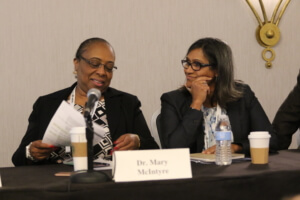
Mary McIntyre, MD, Alabama’s chief medical officer (left) and Ana Novais, executive director of Rhode Island’s Department of Health.
PORTLAND, OR – State health officials shared wide-ranging innovations in their uphill battle against the opioid epidemic that is sweeping their states at the opening day of the National Academy for State Health Policy’s (NASHP) 30th State Health Policy Conference.
Officials explained they are experimenting with new strategies that use data, new treatment approaches, and reconfigured public safety responses to illegal drug use in a race against time as overdose deaths are expected to exceed the 63,000 recorded in 2016.
Kimberly Johnson, MD, director of the US Substance Abuse and Mental Health Services Administration’s Center for Substance Abuse Treatment, ticked off the various strategies and services that are being tried out in state incubator programs that show promise in tackling this national epidemic, including providing treatment on demand, decriminalizing illegal opioid use, creating safe drug use sites and needle exchange programs, improving diagnosis of people with opioid addiction, better use of data to identify drug use patterns in communities, and addiction treatment with medications, such as methadone, which is proven to lower relapse rates.
“The number one thing states can do,” she commented following her opening remarks Monday morning, “is to address prescribing practices among providers. But it really takes all of these strategies to stop this epidemic.”
While NASHP’s three-day conference addressed a host of state public health issues, the nation’s opioid epidemic was a frequent topic at various workshops. It remains the Achilles heel, officials noted, that exposes states’ conflicting and piecemeal public health approaches even while providing opportunities for innovation.
Ana Novais, executive director of Rhode Island’s Department of Health, highlighted her state’s effort to create a dashboard that pulls data from hospitals, police, emergency rescue workers, and providers to create an overdose reporting system. Armed with data, including the latest on fentanyl deaths and locations of overdoses, the state can launch responses that involve police, rescue workers, health care providers and community leaders.
In Ohio – where one in nine of the nation’s heroin overdoses occur — the Office of Health Transformation, led by director Greg Moody, is tackling opioid over-prescribing through a health care reform called value-based pricing that rewards Medicaid managed care providers who provide high-quality care at reasonable prices.
“We wanted to knit together strategies from different domains within state government to address the opioid crisis,” he explained to more than 200 officials who attended the session. To prevent future addictions, Ohio has spearheaded a payment innovation approach to discourage over-prescribing of opioids and reward “best-practice” painkiller prescribing in its Medicaid managed care program.
One of the quality measures Ohio uses to identify “high-value” health care providers is their opioid prescribing practice. The state examines how many opioids a provider – including dentists and orthopedic specialists — prescribe and for how long. Their prescribing practices are compared with the state average. Providers who prescribe above the average amount and duration of painkillers may not get referrals and may eventually lose financial incentives.
Pennsylvania’s approach to prevent future addictions is to provide Medicaid coverage for alternative pain management treatment, such as acupuncture and yoga.
Increasing access to medically-assisted treatment for addiction, educating providers to improve opioid prescribing practices, and building coalitions between public safety and communities to get people into treatment is daunting, officials noted. Some states are proposing to add a work requirement to their Medicaid programs, similar to what exists for adults receiving Temporary Assistance to Needy Families (TANF), which concerned some policymakers. “We want to make sure that if people are working toward recovery that they are not excluded from Medicaid eligibility,” one attendee pointed out.
Another official pointed out that lawmakers in her state wondered how much funding to invest in the naloxone program if emergency personnel keep reviving the same people after multiple overdoses.
“This is a disease,” said David Kelley, MD, chief medical officer of Pennsylvania’s Department of Human Services Office of Medical Assistance Programs, “does an emergency medical technician say, ‘you’ve had angina five times already, we won’t treat you this time?’ Addiction is a disease, we need to stop thinking how many times is enough.”
“We do have to deal with the political ramifications that people still think of addiction as a personal choice,” observed Mary McIntyre, MD, chief medical officer of Alabama’s Department of Public Health.
NASHP will be publishing many of the “State Innovations and Interventions in America’s Opioid Crisis” presentations and slides, and additional blogs in the weeks ahead at oldsite.nashp.org.
Leveraging Multiple State Data Sources to Drive Improvement in Population Health Outcomes
Thursday, July 10, 2014
3:30 – 5:00 pm ET
States have a variety of metrics and data sources that potentially can be used to assess and improve population health outcomes. In order to maximize this potential, states need effective strategies to collect, analyze, integrate, and use data from various sources, and to share it across multiple agencies and health care organizations for activities that drive improvement for all populations.
This webinar features an overview of state opportunities to identify and use data from a variety of sources to examine subpopulations, identify needs, and target interventions to address the needs of distinct populations. The webinar also features a discussion among three states that have taken innovative approaches to using data to drive meaningful changes in health outcomes for various subpopulations with critical needs. Maryland discusses applications of its health information exchange (the Chesapeake Regional Information System for our Patients – CRISP) to identify issues and areas of focus, Ohio describes partnership between Medicaid, managed care plans, and public health agencies to use data to address infant mortality and improve perinatal care quality, and Louisiana highlights how it uses various data sources to create new quality and pay for performance metrics with the goal of improving birth outcomes. Following the panel discussion webinar participants will have an opportunity to ask questions of the presenters.
Speakers:
- Moderator: Sherry Glied, PhD, MA, Dean and Professor of Public Service, New York University’s Robert F. Wagner Graduate School of Public Service
- Mary Applegate, MD, MD, FAAP, FACP, Medicaid Medical Director, Ohio Department of Medicaid
- Rebekah Gee, MD, MPH, MSHPR, FACOG, Medicaid Medical Director, Louisiana; Assistant Professor, Louisiana State University Schools of Public Health and Medicine
- Laura Herrera, MD, MPH, Deputy Secretary of Public Health, Maryland Department of Health and Mental Hygiene
Ohio – Medical Homes
PCMH Education Pilot Project
In 2010, the 128th Ohio General Assembly unanimously enacted Substitute House Bill 198, establishing a patient-centered medical home (PCMH) education advisory group tasked with implementing and administering a PCMH education pilot project. The first phase (planning and practice selection) of the pilot is complete, and the state announced in January 2012 that it would provide $1 million to support workforce training in pilot practices. The pilot includes 47 practices affiliated with four specific medical schools or five specific nursing schools, seven of which are led by nurse practitioners (exceeding the statutory requirement of four). While reviewing applications for participation, the advisory group was required to consider the percentage of a practice’s patients who are part of a medically underserved population, including Medicaid recipients.
Additionally, the advisory group will work with all medical and nursing schools in the state to develop new medical home curricula for medical students, advanced practice nursing students, and primary care residents. The legislation further stipulates that the project cannot require patients to receive a referral from a participating physician to receive specialist care, unless otherwise required by law.
The advisory group is required to submit findings and recommendations six months, one year, and two years after the first funding for the pilot is released. Furthermore, the law added three additional duties specific to medical homes to the Health Care Coverage and Quality Council within the Ohio Department of Insurance; however, the Department of Insurance has since disbanded the council.
More information on the Ohio pilot can be found in the advisory committee’s final work product report.
Federal Support:
- The Cincinatti-Dayton region (including areas of Ohio and Kentucky) is one of seven markets participating in CMS’s Comprehensive Primary Care Initiative (CPCi). In this multi-payer initiative, Medicare is collaborating with public and private insurers in the selected states or regions with the goal of strengthening primary care. CPCi launched in November 2012, bringing together ten payers in Ohio and Kentucky, as well as 75 participating primary care practices with 276 providers across the region.
- On September 17, 2012, the Centers for Medicare & Medicaid Services (CMS) approved a Section 2703 health home state plan amendment for Medicaid enrollees with chronic conditions. The SPA targets patients with serious and persistent mental illness served by community behavioral health centers in five counties. To learn more about Section 2703 Health Homes, visit the CMS Health Homes webpage.
- HealthBridge, serving the greater Cincinnati area (including parts of Kentucky and Indiana), has received a Beacon Community Grant.
Last Updated: April 2014
| Forming Partnership |
PCMH Education Pilot Project: Substitute House Bill 198 (128thGeneral Assembly) established an eighteen-member patient-centered medical home (PCMH) education advisory group. Membership statutorily includes:
Voting:
Non-voting, ex officio:
The advisory group also hosted a statewide webinar and four regional town hall meetings to educate prospective practices and receive feedback from stakeholders.
In addition to administering the pilot, the act directs the advisory group to work jointly with state medical and nursing schools to develop new curricula to prepare future primary care providers for the PCMH model of care.
|
| Defining & Recognizing a Medical Home |
Definition:
PCMH Education Pilot Project: Substitute House Bill 198 (128thGeneral Assembly) specifies that: “the patient-centered medical home model of care is an enhanced model of primary care in which care teams attend to the multifaceted needs of patients, providing whole person comprehensive and coordinated patient centered care.” The state’s PCMH website expands on this, outlining core features of a patient-centered medical home:
Recognition:
PCMH Education Pilot Project: TransforMED evaluated pilot applicants for their potential to become patient-centered medical homes. Also, while there are no current recognition requirements to participate, the patient-centered medical home education advisory group referenced the 2011 NCQA medical home standards in their final work product report.
ACA Section 2703 State Plan Amendment – Community Behavioral Health Centers (CBHCs): Participating CBHCs are required to achieve The Joint Commission’s Behavioral Health Care Accreditation Program Standards for Primary Physical Health Care or NCQA Level 1 PCMH recognition. In additon, providers are required to provide all core health home services; to integrate physical and behavioral health care; to have agreements with primary care providers if not co-located; to establish partnerships with managed care plans to support coordination between health homes and plans; and to have a variety of data collection and reporting capabilities.
CMS’s Comprehensive Primary Care Initiative (CPCi): Practices were selected for participation in CPCi through a competitive application process. Under CMS’s Comprehensive Primary Care Initiative, practices are not required to attain formal PCMH recognition; however, formal PCMH recognition through NCQA, AAHCC, the Joint Commission, URAC, or a state-based recognition program was viewed favorably in practice selection. Additional criteria included:
CMS’s Comprehensive Primary Care Initiative (CPCi): – See more at: https://www.oldsite.nashp.org/med-home-states/arkansas#sthash.4T6f6iyo.dpuf
CMS’s Comprehensive Primary Care Initiative (CPCi): – See more at: https://www.oldsite.nashp.org/med-home-states/arkansas#sthash.4T6f6iyo.dpuf
CMS’s Comprehensive Primary Care Initiative (CPCi): – See more at: https://www.oldsite.nashp.org/med-home-states/arkansas#sthash.4T6f6iyo.dpuf
|
| Aligning Reimbursement & Purchasing |
PCMH Education Pilot Project: Substitute House Bill 198 (128thGeneral Assembly) requires the patient-centered medical home education advisory group to reimburse up to 75 percent of a practice’s health information technology investments for participating primary care practices (including training and technical support). Ohio is using meaningful use incentives in the HITECH Act to meet this requirement.
ACA Section 2703 State Plan Amendment – Community Behavioral Health Centers (CBHCs): Participating practices will receive a monthly case rate. Rates will varey by health home based on caseload and dedicated health home staffing costs for each qualifying enrollee.
CMS’s Comprehensive Primary Care Initiative (CPCi): This four-year multi-payer initiative, launched in October 2012, includes ten payers in the Cincinatti-Dayton market: Medicare, Ohio Medicaid, Aetna, Amerigroup, Anthem Blue Cross Blue Shield Ohio, CareSource, Centene Corporation, Humana, HealthSpan, Medical Mutual, and UnitedHealthcare.
Medicare pays selected practices a per-beneficiary per-month (PBPM) risk-adjusted care management fee which ranges from $8 to $40. CMS has indicated that it expects care management fees to average $20 PBPM during the first two years of the initiative. In Years 3 and 4, care management fees will average $15 PBPM. Medicare will also introduce a shared savings component beginning in Year 2, calculated at the market level.
The CPCi solicitation for payers indicates that participating payers (non-Medicare) are expected to follow a similar framework, paying per-member per-month (PMPM) care management fees to participating practices on top of fee-for-service and incorporating a shared savings component. Payment amounts will be negotiated individually with participating practices to comply with anti-trust laws.
|
| Supporting Practices |
PCMH Education Pilot Project: Substitute House Bill 198 (128th General Assembly) requires participating practices to receive comprehensive training on medical home operations, including leadership training, scheduling changes, staff support and care management.
ACA Section 2703 State Plan Amendment – Community Behavioral Health Centers (CBHCs): The Ohio Department of Mental Health and Ohio Office of Medical Assistance launched a Health Home Learning Community in February 2013. The state reports that it plans to “include a series of accelerated and intensive in-person and virtual learning sessions on a variety of topics including integration of physical and behavioral health needs, transitions in care, and assertive outreach and engagement with input from community mental health centers and key partners. The series will focus on high-quality care, improving care coordination and enhancing the consumer experience.” For more information on technical assistance for health home practices, visit the Ohio Medicaid Health Homes webpage.
|
| Measuring Results |
PCMH Education Pilot Project: The patient-centered medical home (PCMH) education advisory group selected a number of practice and curriculum metrics. The selected metrics fall into six categories:
For specific measures selected, please see pages 7-8 of the advisory group’s final work product report.
ACA Section 2703 State Plan Amendment – Community Behavioral Health Centers (CBHCs): Ohio will use claims data to evaluate progress toward the state’s eight goals for the health home program:
|
Ohio
In Ohio:
- 2,129,706 beneficiaries were enrolled in Medicaid as of July 1, 2011. Of these, 1,605,821 were enrolled in managed care through seven Medicaid-only managed care organizations (MCOs). The state has a full-risk managed care program operated under a 1932(a) State Plan Amendment.
- Physical and oral health services (including the EPSDT benefit) are delivered through managed care. Children are mandatorily enrolled in MCOs. Behavioral health benefits delivered through the state’s community behavioral health system (primarily state-certified community mental health centers) are paid for on a fee-for-service basis; services not obtained through this system are covered by managed care plans.
As of 2013, 1,449,772 individuals were eligible for Healthchek (the Early and Periodic Screening, Diagnostic, and Treatment, or EPSDT, benefit) through Ohio Medicaid. According to CMS data from 2013, Ohio achieved an EPSDT screening ratio of 33% and a participation ratio of 30%. 309,806 children received dental services of any kind, with 263,717 receiving preventive dental services.
Last updated June 2014
| Medical Necessity |
According to regulations (Ohio Administrative Code 5160-1-01) in Ohio:
"’Medical necessity’ is a fundamental concept underlying the medicaid program. Physicians, dentists, and limited practitioners render, authorize, or prescribe medical services within the scope of their licensure and based on their professional judgment regarding medical services needed by an individual. Unless a more specific definition regarding medical necessity for a particular category of service is included within division-level 5101:3 of the Administrative Code, ‘medically necessary services’ are defined as services that are necessary for the diagnosis or treatment of disease, illness, or injury and without which the patient can be expected to suffer prolonged, increased or new morbidity, impairment of function, dysfunction of a body organ or part, or significant pain and discomfort. A medically necessary service must:
|
| Initiatives to Improve Access |
Managed care contracts in Ohio require health plans to have on staff an “EPSDT/Maternal Child Health Manager” to help Medicaid-enrolled families navigate the health care system and access EPSDT benefits.
These managers also help to coordinate services specific to the maternal and child health needs of enrollees and link members to community-based resources.
|
| Reporting & Data Collection |
Appendix M of Ohio’s managed care contracts specify minimum performance standards on select quality measures. Several child-specific measures specified in the contracts are NCQA Healthcare Effectiveness Data and Information Set (HEDIS) metrics, including measures of child and adolescent access to primary care and number of child and adolescent well-care visits. The contracts also gauge performance based on children’s rating of a health plan (in a CAHPS survey) and use a CHIPRA core set measure of asthma-related emergency room visits.
|
| Behavioral Health |
Community mental health centers can apply to become Medicaid Health Home providers, offering services to individuals with serious and persistent mental illness. Services offered through Medicaid Health Homes include: “comprehensive care management, care coordination, health promotion, comprehensive transitional care, individual and family support services, referrals to community and social support services, and the use of health information technology to link health home activities.”
|
| Support to Providers and Families |
Ohio’s Department of Jobs and Family Services (which houses Medicaid) has produced EPSDT services brochures for families. In addition, managed care contracts require that managed care organizations provide families with member handbooks that at least include: descriptions of screening and treatment services under the EPSDT benefit; the state’s periodicity schedule; clarification that EPSDT services are provided to children with no cost-sharing; and information on prior authorization requirements.
Managed care organizations must also annually educate providers on the EPSDT benefit, including: components of a screen; the state’s periodicity schedule; and common billing codes and procedures related to services under the EPSDT benefit.
|
| Care Coordination |
Managed care organizations (MCOs) in Ohio are required to engage in a number of care coordination activities, including:
The MCO must employ a Care Management Director, a nurse responsible for operating a Care Management Program and ensuring Medicaid beneficiaries’ services are coordinated. Plans are also responsible for coordinating behavioral health services with physical health services, including services obtained through the community behavioral health system (behavioral health services for which the MCO is not financially responsible).
|
| Oral Health |
Ohio
NASHP’s Accountable Care Activity map is a work in progress; state activity pages will be launched in waves throughout Fall 2012.
At this time, we have no information on accountable care activity that meets the following criteria: (1) Medicaid or CHIP agency participation (not necessarily leadership); (2) explicitly intended to advance accountable or integrated care models; and (3) evidence of commitment, such as workgroups, legislation, executive orders, or dedicated staff.
If you have information about accountable care activity in your state, please email skinsler@oldsite.nashp.org.
Last updated: October 2012
Minnesota and Ohio: Advancing Health Equity through Delivery System Reform
 By Carrie Hanlon
August 2012
Racial and ethnic minorities disproportionately experience chronic disease, often receive suboptimal quality care and therefore can benefit most from delivery reform initiatives aiming to improve quality and care coordination, particularly for the chronically ill. Through a variety of provisions, the Affordable Care Act (ACA) facilitates state and federal action to advance health equity for racial and ethnic minorities. Minnesota and Ohio participated in a recent NASHP learning collaborative, and their efforts demonstrate four ways states can incorporate health equity into delivery reform initiatives to ensure high-quality, equitable care for all.
Read more
 For individuals living with complex, often chronic conditions, and their families, palliative care can provide relief from symptoms, improve satisfaction and outcomes, and help address critical mental and spiritual needs during difficult times. Now more than ever, there is growing recognition of the importance of palliative care services for individuals with serious illness, such as advance care planning, pain and symptom management, care coordination, and team-based, multi-disciplinary support. These services can help patients and families cope with the symptoms and stressors of disease, better anticipate and avoid crises, and reduce unnecessary and/or unwanted care. While this model is grounded in evidence that demonstrates improved quality of life, better outcomes, and reduced cost for patients, only a fraction of individuals who could benefit from palliative care receive it.
































































