
States Drive Innovations in Quality Measurement and Improvement for Children with Special Health Care Needs
Children and youth with special health care needs (CYSHCN) are a diverse population whose health care needs and costs often exceed those of most children. Improving care for this population is critical, yet challenging, due to the complexity of conditions of some children, and the multitude of systems (e.g., health, education, social services) and supports that children typically use.
With Medicaid and CHIP programs financing health care services for 44 percent of all CYSHCN in the United States, state Medicaid agencies are increasingly targeting CYSHCN as part of their health system transformation efforts to improve health care quality and outcomes. A recent NASHP 50-state scan of state Medicaid managed care programs found that 37 states and Washington, DC, now enroll some or all populations of CYSHCN in risk-based Medicaid managed care. As state payment and delivery system reform efforts advance, tailoring quality measurement and improvement strategies to CYSHCN is a growing priority for many states to improve care for this vulnerable population.

Shutterstock.com
Despite this growing interest, states face numerous barriers in implementing quality improvement strategies for CYSHCN. For example, many Medicaid agencies lack the resources and capacity to develop robust quality improvement initiatives for this population of children. Many existing quality measures have limitations in their applicability across all CYSHCN populations, and may not fully assess the overall quality of care. Surveys that can be used to measure family experience with care are often challenging and burdensome to administer. Quality improvement is a lengthy and iterative process and requires substantial time and resources for non-complex patient populations. These challenges are more pronounced when developing quality improvement initiatives that meet the unique needs of CYSHCN.
Some state Medicaid agencies, however, are leading the way by designing innovative programs and exploring new ways to align and embed quality measurement for CYSHCN in within broader state initiatives.
- Michigan: Michigan’s Children’s Special Health Care Services (CSHCS) program serves children with special needs. Michigan Medicaid utilizes the Consumer Assessment of Healthcare Providers and Systems 5.0 Child Medicaid Health Plan Survey with the Children with Chronic Conditions measurement set to assess the experience of care and quality of care for children enrolled in the CSHCS program. The survey results are used to guide improvements in the CSHCS program, and they are factored into incentive payments for the state’s managed care organizations (MCOs).
- New York: As part of New York’s overall Medicaid Redesign Team initiatives, the state is changing how children, including CYSHCN, are served in the state’s Medicaid program. One new program that is specifically driving quality measurement and improvement for CYSHCN is Health Homes Serving Children (HHSC). Through this program, participating Health Homes use a care management model to support to Medicaid-enrolled children with complex physical and/or behavioral health conditions. Health Homes report on the “Health Homes Measures Subset,” which is a list of performance measures designed to assess members’ well-being and the impact of care management activities. Some of these measures include adolescent well-care visits, time from health home referral to outreach, and follow-up after hospitalization for mental illness. The HHSC program also develops and maintains a Quality Management Program that monitors, evaluates, and ultimately improves the quality of care for members. The current quality measurement activities are laying the groundwork for New York to eventually integrate Health Homes into its statewide transition to value-based payments, with the goal of holding Health Homes accountable for the quality of care rendered and the outcomes of their members.
- Texas: Texas Medicaid serves children and youth with disabilities and complex conditions in a specialized managed care program called STAR Kids, which uses several strategies to measure and improve the quality of care for enrollees. Prior to the launch of STAR Kids, a study established baseline data for utilization, access, and consumer satisfaction. Now that the program is in its first year, Texas Medicaid will conduct a post-implementation survey of the children enrolled in STAR Kids to assess its performance, compare the performance of MCOs, and determine which measures to integrate into future quality improvement activities. Texas Medicaid also plans to implement additional quality improvement activities for STAR Kids over the next several years, including releasing MCO report cards that can help STAR Kids enrollees and their families select a health plan, and linking financial incentives and disincentives to MCO performance.
To learn more about these and other innovative Medicaid quality measurement strategies targeted to CYSHCN, read NASHP’s new issue brief, State Strategies for Medicaid Quality Improvement for Children and Youth with Special Health Care Needs. The brief includes a table highlighting selected Medicaid quality measurement sets and tools for children, and three case studies featuring ongoing work Michigan, New York, and Texas.
For more information about NASHP’s work on Medicaid Quality Measurement and CYSHCN, contact Becky Normile at bnormile@oldsite.nashp.org.
States Share Data to Improve the Health of People Living with HIV
| Virologic Suppression occurs when the amount of HIV in the blood is lowered to below 200 copies per milliliter or undetectable levels.PLWH are more likely to achieve and maintain virologic suppression when they have access to high-quality, coordinated and comprehensive care, antiretroviral therapy, and support services. A substantial body of research shows that virally-suppressed people have better health outcomes and are at significantly reduced risk of sexually transmitting HIV to others. Source: Centers for Disease Control and Prevention. “HIV Treatment as Prevention.” Accessed November 13, 2017. https://www.cdc.gov/hiv/risk/art/index.html. |
Research shows that people living with HIV (PLWH) who achieve and maintain virologic suppression at undetectable levels have better health outcomes and reduced risk of transmitting HIV to others. As a result, many states have made increasing rates of virologic suppression in Medicaid and Children’s Health Insurance Program (CHIP) beneficiaries living with HIV a high priority. States are increasingly using data analytics to better understand PLWA’s health care engagement and outcomes in order to improve state policies and programs.
In 2016, Medicaid and health departments from 19 states with diverse geographic regions and varying HIV rates joined the HIV Health Improvement Affinity Group. The states represent more than 50 percent of people living with HIV in the United States as of 2014.
Each affinity group state developed a quality improvement project and received technical assistance to strengthen state strategies that increase virologic suppression for Medicaid and CHIP beneficiaries living with HIV. Overwhelmingly, these states identified the need to understand this population’s service utilization and health outcomes in order to inform policy and program improvements. To do this, states can share and compare data sets from HIV prevention, treatment, and surveillance programs and Medicaid. While data sharing and analysis can be complex — due to federal and state laws and the need for a strong information technology (IT) infrastructure — states in the affinity group are leading the way.
| HIV Health Improvement Affinity Group The HIV Health Improvement Affinity Group (HHIAG) provided support to 19 state Medicaid and public health department teams (highlighted in blue) working to increase rates of sustained virologic suppression among Medicaid and Children’s Health Insurance Program (CHIP) beneficiaries living with HIV.The HHIAG was a joint initiative of the Centers for Medicare & Medicaid Services, the Centers for Disease Control and Prevention, and the Health Resources and Services Administration, in collaboration with the Health and Human Services’ Office of HIV/AIDS and Infectious Disease Policy, and in partnership with NASHP.  |
 Prior to the Affinity Group, there was a very limited working relationship between the Alaska HIV Program and Medicaid. Their collaboration throughout the affinity group allowed leaders from both programs to establish a data use agreement (DUA), providing the HIV Program access to Medicaid claims data. HIV Program staff have completed a match of HIV surveillance data to Medicaid claims to better understand the utilization of services by people living with HIV enrolled in Medicaid and their HIV viral load. HIV Program and Medicaid staff believe this data analysis will allow them to better target limited resources to PLWH who are not regularly seeking HIV care and/or filling their medications.
 Maryland state officials recognized the need for a DUA between the Maryland Department of Health and the Office of Health Care Financing (Medicaid) so that HIV program staff could access Medicaid claims data. They are now in the process of finalizing a DUA that will allow regular transfers of Medicaid claims data to the state’s HIV Program. While the DUA was being written, Maryland created a list of claims-based codes that could indicate if a beneficiary is HIV positive, received HIV testing, or received pre-exposure prophylaxis (PrEP). Once the DUA is in place, these codes will be used by data analytics staff to identify and describe beneficiaries using that criteria. Maryland will also create data files of HIV-positive beneficiaries for future analysis of claims utilization.
 Louisiana finalized a DUA in 2014 that allows Medicaid claims data to be shared with the state health department. The state runs quarterly analyses that compare Medicaid claims data with HIV surveillance data to identify Medicaid beneficiaries who have an HIV diagnosis, but are not accessing or engaging in HIV care, and whether or not they are virally suppressed. Medicaid managed care plans in the state receive updates about their enrolled members’ results from each quarterly analysis. Based on these reports, plans can reach out to members who are not yet engaged in HIV care and/or not virally suppressed, and help them access necessary services. Louisiana currently incentivizes plans to increase virologic suppression rates by including viral load suppression as one of nine incentive-based quality metrics. If plans do not achieve an established target for an incentive-based measure, they may be subject to monetary penalties.
More promising strategies, state examples, and technical assistance resources describing how states can improve rates of viral load suppression will soon be published in a NASHP toolkit and explored in a national webinar. Visit NASHP.org and read its weekly e-newsletter for information about the release of the toolkit in mid-December.
To register for the webinar on Dec. 6, 2017, click here.
FQHC Readiness and Practice Transformation Strategies
The National Academy for State Health Policy (NASHP) designed this toolkit to support states interested in developing a value-based alternative payment methodology (APM) for federally qualified health centers (FQHCs). The following section on FQHC readiness and practice transformation discusses key considerations and promising strategies based on lessons learned from states during NASHP’s Value-Based Payment Reform Academy.
Key considerations for FQHC readiness and practice transformation include:
- Engage the PCA to provide clinician and staff education, training, and resources.
- Assess FQHC interest and readiness in the early stages of APM development.
- To prepare for implementation, FQHCs will want to consider their short- and long-term financial, information technology (IT), and staff capacity.
Background
For FQHCs, transitioning to a value-based APM often requires additional infrastructure and investment, such as enhanced IT and quality improvement capacity, as well as clinical and work flow changes, including team-based care, population-based management, and care coordination. FQHCs may also need to change how clinicians and other staff work together and with community partners to improve quality and efficiency.
While challenging, the transition to a value-based APM offers benefits to practices, including the opportunity to support team-based care models that can improve health care quality and enhance workforce retention and recruitment. Depending on staffing, IT capacity, and available financial resources, FQHCs will vary in how quickly they can transform their practices. FQHCs must individually agree to participate in an APM, so not all FQHCs in the state need to be ready to launch at the same time. States may find it beneficial to pilot an APM with a few FQHCs and refine the model as necessary.
Key Considerations
Engage the PCA to provide clinician and staff education, training, and resources.
PCAs are state or regional entities that provide training and technical assistance to safety net providers.[i] PCAs are an important partner for states, and serve as a conduit for outreach and education about value-based purchasing to FQHCs. PCAs can also assist states in assessing FQHC capacity to take on value-based APMs. For example, value-based payment has become a board-level priority for PCAs in both Colorado and Michigan and each has provided technical assistance to FQHCs on the topic. The PCA in Hawaii is also engaged in educating its members to increase understanding of value-based APM development and implementation.
The PCA can provide support to FQHCs as they transition to a value-based APM. The Oregon PCA developed the Advanced Care Model learning collaborative in partnership with FQHCs and the Medicaid agency to help FQHCs transition to the PMPM APM. As part of this learning collaborative, FQHCs have access to practice transformation and implementation support through on-site technical assistance, webinars, networking, and strategic planning.
Readiness Considerations for FQHCs
Source: Laura Sisulak. “Clinic Readiness, Preparation, and Support.” PowerPoint, National Academy for State Health Policy’s Value Based Payment Reform Academy Closing Meeting, July 26, 2017. |
Assess FQHC interest and readiness in the early stages of APM development.
Readiness assessments can help states identify which FQHCs have the capacity to take on a value-based APM, and also pinpoint where the state and PCA should provide technical assistance to help increase FQHC capacity. Several FQHC-specific readiness tools are available, including the NACHC Payment Reform Readiness Assessment Tool, the Health Management Associates Value-Based Payment Assessment Tool (developed in partnership with the District of Columbia, one of NASHP’s Value-Based Payment Reform Academy states), and the University of Iowa Value-Based Care Assessment Tool, which was specifically developed for rural health providers.
To prepare for implementation, FQHCs will want to consider their short- and long-term financial, IT, and staff capacity.
In addition to having a clear vision for practice transformation, FQHCs should also assess financial readiness, IT capacity, and staffing needs.
Financial Considerations
FQHC participation criteria will be unique to each state, and depend on the structure of the APM. Both states and FQHCs may benefit from a participation agreement that clearly identifies the responsibilities of the state and of the FQHC.[ii]
Prior to adopting a value-based APM, FQHCs may assess:
- Days cash on hand
- Available financial resources to support necessary practice transformation efforts
- Payer mix
-
- Consider the number of Medicaid lives. It may be challenging to participate in payment reform if the FQHC serves fewer than 1,000 active Medicaid patients
- Consider the amount of visit-based revenue the practice will continue to generate
- Average Medicaid visits per patient, per year
- Stability of historical utilization
- Stability/predictability of patient population
- Low visit rate per patient, per year
Because FQHC participation in any value-based APM is voluntary under Section 1902(bb) of the Social Security Act,[iii] FQHCs may revert back to PPS if participation causes them financial distress. States will want to have a process for exiting the program without financial hardship or impact on patient care.
Data and Health IT
States and FQHCs require accurate, timely data to calculate practice performance on quality and/or cost targets. States will typically use claims or encounter data to calculate measures tied to payment but may require additional reporting from FQHCs on outcome-based quality measures or other types of clinic-based measures. As FQHCs take on more advanced value-based APMs, they will need robust health IT and analytics capacity to support quality improvement initiatives, perform population health management activities, maintain attribution lists, facilitate coordinated care, and report data as required by state participation agreements. Health Center Controlled Networks (HCCNs)—groups of health centers working together to address health information technology challenges—are active in 38 states[iv] and are used by about 70 percent of health centers.[v] Partnership with a HCCN may help to leverage limited FQHC resources, and provide technical assistance, particularly related to data analysis to support quality measure and improvement.[vi]
Staffing
Participation in a value-based APM requires FQHC leadership to have a clear strategic vision and strong commitment to changing how care is delivered through new clinical and workflow processes. It may also require investment in new types of staff, such as care coordinators or community health workers, and additional training. FQHCs interested in participating in a value-based APM may need to assess:
- Board Commitment
- Stability of leadership team
- Their capacity for and history of change management
- Assessment of competing priorities (new electronic health record systems, new practice sites and services, etc.)
- Adequate operations, clinical, and quality improvement staff, and staff training capacity. Participation may require:
- Implementing a new payment system, understanding new billing and reporting processes, managing attributed patient lists;
- Adapting to new clinical care processes, working with internal or external care managers, incorporating data into clinical work flows, identifying and formalizing partnerships with community providers;
- Developing and integrating internal and external reporting on key indicators (e.g., measurement, cost, access);
- Implementing quality improvement processes or rapid cycle improvement strategies; and
- Working with state and community partners to impact upstream utilization.
For more resources about FQHC readiness and practice transformation within a value-based APM, use the resources tab. To view additional information about developing a value-based APM for FQHCs, return to the toolkit home.
[i] Health Resources & Services Administration, “Primary Care Associations.” Accessed October 18, 2017. https://bphc.hrsa.gov/qualityimprovement/strategicpartnerships/ncapca/associations.html.
[ii] States may find an example participation agreement from Oregon in the resources tab.
[iii] Social Security Act, 42 U.S.C. § 1902.
[iv] National Association of Community Health Centers, “All Network Data.” Accessed September 29, 2017, https://nrg.nachc.org/networkdata/all-network-data/.
[v] Health Resources & Services Administration, “Health Center Controlled Networks,” accessed September 29, 2017, https://bphc.hrsa.gov/qualityimprovement/strategicpartnerships/hccn.html. To find a HCCN in your state, please visit this interactive map: https://findanetwork.hrsa.gov/
[vi] Ibid.
Policy Levers to Develop Value-Based Payment Models for FQHCs
The National Academy for State Health Policy (NASHP) designed this tool kit to support states interested in developing a value-based alternative payment methodology (APM) for federally qualified health centers (FQHCs). The following section on state policy levers for implementation discusses key considerations and promising strategies based on lessons learned from states during NASHP’s Value-Based Payment Reform Academy.
Key considerations for state implementation include:
- States can amend current FQHC Medicaid state plan language to support value-based APMs.
- States can consider other Medicaid state plan options to support value-based payments for FQHCs.
- States can incorporate APMs for FQHCs in waiver applications to test new ways of delivering or paying for care that include FQHCs.
Background
Medicaid agencies have a number of policy options to consider when developing an APM approach for FQHCs. States can submit an state plan amendment (SPA) that updates FQHC-specific portions of their state plans, or they can develop a more expansive SPA that creates a new payment mechanism to support value-based models, such as accountable care organizations (ACOs). SPAs do not need to be budget neutral.[i] States may also elect to submit a waiver to implement and test broad payment reform innovations. Regardless of the Medicaid authority selected, state policymakers report that early engagement of Centers for Medicare & Medicaid Services’ central and/or regional office leadership in the planning process can help to troubleshoot concerns related to federal regulations on FQHC reimbursement.
Key Considerations
States can amend current FQHC Medicaid state plan language to support value-based APMs.
The District of Columbia is implementing its pay-for-performance APM through a SPA to the FQHC section of its state plan, which was approved in September 2017.[ii] The District will launch the APM at the beginning of fiscal year 2018. FQHCs that elect to participate in the APM will receive a supplemental performance payment if they perform at or above a target threshold or if they improve their performance from the baseline year on nine required measures.[iii]
Oregon also implemented its value-based APM through an approved SPA to its FQHC language, which was approved in September 2012 and launched in 2013.[iv] The SPA covers components such as:
- Assurances that FQHCs that do not want to participate in the APM will be paid under PPS, as required by federal regulations in Section 1902(bb) of the Social Security Act;[v]
- Details of the PMPM payment rate calculation, based on attributed patients and average historical utilization; and
- A description of the reconciliation process to ensure that aggregate PMPM payments to FQHCs are at least equivalent to what they would have received under PPS, per Section 1902(bb) of the Social Security Act.[vi]
States can consider other Medicaid state plan options to support value-based payments for FQHCs.
Integrated Care Models, described in a 2012 State Medicaid Director letter, provide additional flexibility to states to support value-based payment systems that can include FQHCs.[vii] Minnesota implemented its Integrated Health Partnerships (IHP), a Medicaid ACO initiative, through an approved Integrated Care Models SPA. The SPA details how cost, quality targets, and shared savings are calculated, and describes criteria for providers or provider groups that would like to participate. The SPA also includes FQHC services as eligible “core services” under the initiative, facilitating the participation of groups of FQHCs, such as FUHN, to participate.[viii]
States can incorporate APMs for FQHCs in waiver applications to test new ways of delivering or paying for care that include FQHCs.[ix]
FQHC value-based APMs can be a part of a broader state 1115 waiver initiative. Approved waivers allow states to forgo one or more federal Medicaid requirements; however, they are typically time-limited and have significant reporting requirements.[x] Massachusetts will begin its accountable care organization (ACO) initiative in March 2018[xi] as part of its five-year 1115 Medicaid waiver.[xii] The state has contracted with 17 ACOs, including an ACO formed by 13 FQHCs, to participate in the ACO program. Massachusetts’ ACO program is designed to improve care quality and patient experience, while reducing costs through better integration and coordination of physical and behavioral health and long-term care.[xiii]
For more resources about state policy levers to implement value-based APMs, see the resources tab. To view additional information about developing a value-based APM for FQHCs, return to the toolkit home.
[i] 42 CFR 430.32; Medicaid and CHIP Payment and Access Commission, “State Plan,” accessed September 29, 2017.
[ii] Centers for Medicare & Medicaid Services, approval letter, District of Columbia State Plan Amendment related to Pay-for-Performance (IHP) Program, September 20, 2017. https://www.medicaid.gov/State-resource-center/Medicaid-State-Plan-Amendments/Downloads/DC/DC-16-009.pdf.
[iii] District of Columbia Department of Health Care Finance, Notice of Emergency and Proposed Rulemaking, Governing Medicaid Reimbursement for Federally Qualified Health Centers, October 6, 2017. https://www.dcregs.dc.gov/Common/DCMR/SectionList.aspx?SectionNumber=29-4502.
[iv] Centers for Medicare & Medicaid Services, State Plan Amendment, State Plan Under Title XIX of the Social Security Act: Oregon, accessed November 20, 2017, https://www.medicaid.gov/State-resource-center/Medicaid-State-Plan-Amendments/Downloads/OR/OR-12-008-AtT.pdf.
[v] Social Security Act, 42 U.S.C. § 1902.
[vi] Ibid. Centers for Medicare & Medicaid Services, amendment, State Plan Under Title XIX of the Social Security Act: Oregon, accessed September 29, 2017, https://www.medicaid.gov/State-resource-center/Medicaid-State-Plan-Amendments/Downloads/OR/OR-12-008-AtT.pdf.
[vii] Center for Medicaid and CHIP Services, letter to state Medicaid Directors: SMDL# 12-001, Integrated Care Models, July 10, 2012. https://www.medicaid.gov/federal-policy-guidance/downloads/smd-12-001.pdf.
[viii] Centers for Medicare & Medicaid Services, approval letter, Minnesota State Plan Amendment related to Integrated Health Partnership (IHP) Program, September 20, 2016. https://mn.gov/dhs/assets/15-15-spa_tcm1053-270779.pdf.
[ix] Medicaid and CHIP Payment and Access Commission. “Waivers.” Accessed September 29, 2017. https://www.macpac.gov/subtopic/waivers/.
[x] To learn more about the different types of waivers and waiver requirements, visit https://www.macpac.gov/subtopic/waivers/.
[xi] Massachusetts Department of Health and Human Services, Press Release: MassHealth Partners with 17 Health Care Organizations to Improve Health Care Outcomes for Members, August 17, 2017. Accessed November 15, 2017. https://www.mass.gov/eohhs/gov/newsroom/press-releases/eohhs/masshealth-partners-with-17-health-care-organizations.html.
[xii] Mass.gov. “1115 Waiver.” Accessed November 14, 2017. https://www.mass.gov/service-details/1115-waiver.
[xiii] Ibid.
States Work to Improve Care for Children with Special Health Needs with Quality Measurement
Improving the quality of care that children and youth with special health care needs (CYSHCN) receive is a growing priority for state Medicaid programs. However, many quality improvement efforts are in their infancy as states work to overcome the challenges of measuring and assessing care quality for this vulnerable population. NASHP, with support from the Lucile Packard Foundation for Children’s Health, convened a national work group recently to identify gaps and opportunities in measuring care and designing quality improvement initiatives. This issue brief and case studies from Michigan, New York, and Texas, examine strategies that states can use to advance quality measurement and improvement for CYSHCN.
State Health Policymakers Look to Washington and Each Other to Fight the Opioid Epidemic
In the last two weeks, there has been a flurry of federal and state activity focused on the nation’s opioid epidemic that currently kills more Americans than guns or car accidents.
- In Washington, the President’s Commission on Combating Drug Addiction and the Opioid Crisis released its final report featuring 56 recommendations to stem opioid and substance abuse and improve treatment, followed by a State Medicaid Director Letter from the Centers for Medicare & Medicaid Services (CMS), outlining expanded flexibility for states seeking Section 1115 Waivers to address the problem.
- At the annual National Academy for State Health Policy (NASHP) conference, it was standing room only at a day-long session entitled State Innovations and Interventions in America’s Opioid Crisis. State health officials from across the country shared their new approaches, which ranged from treatment improvements, innovative use of data, and coalition-building between public safety, businesses, and communities to stem the epidemic that claimed more than 64,000 lives in 2016.
| For more details about how states are combatting the opioid crisis, explore NASHP’s State Innovations and Interventions in America’s Opioid Crisis Preconference resource book. |
While it’s unclear whether the Trump Administration will adopt all of the commission’s recommendations, which include additional block grant funding and federal incentives for evidence-based programs, the state Medicaid directors’ letter offered guidance for state officials interested in using Section 1115 Waivers to create innovative or experimental programs that meet the goals of Medicaid. In this case, states could use Section 1115 Waivers to expand or create new prevention and treatment initiatives in order to provide a fuller continuum of services to address opioid use disorders within their states.
Section 1115 of the Social Security Act permits CMS to waive certain federal Medicaid requirements so states have more flexibility to innovate and test new models of care, including providing services and expanding Medicaid in ways not typically permitted under current Medicaid rules. States must show that their initiatives still align with the purposes of the Medicaid program, and their waiver applications can be far-reaching or narrowly tailored, and usually require discussion and negotiation with federal partners.
The recent Medicaid letter reiterates the ability of CMS to waive the restrictive “Institutions for Mental Disease” or IMD exclusion, which would enable state Medicaid programs to receive federal financial participation (FFP) support for those facilities that treat opioid use disorders. The guidance notes that IMD costs do not include room and board unless those settings qualify as inpatient facilities.
Additionally, while states may submit an implementation plan after they apply for the waiver, IMD costs will only be paid prospectively once the plan has been approved. Moreover, interested states will need to demonstrate their ability to make improvements on a number of additional goals and milestones, and, as with other 1115 Waivers, the cost of the waiver initiative must be budget-neutral, and incur no costs beyond what the federal government would otherwise have paid.
States may access technical support and resources from the Innovation Accelerator Program to develop their 1115 Waivers. The administration recently approved its first substance use disorder-focused waiver application from West Virginia, which provides additional insight for states looking to go in this direction.
West Virginia’s 1115 Waiver enables the state to expand its substance use disorder (SUD) treatment to include methadone treatment services, peer recovery support services, withdrawal management services, and short-term residential services to all Medicaid enrollees.
“In implementing the SUD demonstration, West Virginia is delivering SUD services through comprehensive managed care plans for managed care enrollees and introducing new policy, provider and managed care requirements to improve quality of the care delivered to West Virginia Medicaid beneficiaries and to ensure that SUD treatment services are delivered consistent with national treatment guidelines established in the American Society of Addiction Medicine Criteria,” CMS officials wrote in their letter announcing the waiver.
“In addition, West Virginia is taking steps to improve the quality and access to care for West Virginia Medicaid beneficiaries with SUD, such as introducing new care coordination features and collecting and reporting quality and performance measures,” they noted. While obtaining financial support for services in IMD may help support a full continuum of services for SUDs, states are also moving forward with innovative community-based approaches, using other funding and policy levers. Examples from the NASHP preconference include:
- The Drug Free Moms and Babies Program in West Virginia, spearheaded by that state’s Office of Maternal and Child Health. The program is decreasing the presence of illicit substances at delivery through screening and comprehensive care, including long-term follow-up.
- Connecticut’s multi-pronged approach incorporates increased use of medication-assisted treatment in corrections settings, a statewide access line with transportation, and targeted supports in emergency departments to initiate treatment, including recovery coaches.
- Ohio’s Episodes of Care payment model measures share data on opioid prescribing in connection with dental extraction, a common pathway for opioid access.
Federal focus on the opioid crisis is expected to produce tangible supports for state policymakers who are on the frontlines of the opioid epidemic. In the meantime, policymakers attending the NASHP conference concurred that they will continue to serve as the leaders, innovators, and problem-solvers in their battles against this devastating epidemic.
Surgeon General Jerome Adams Discusses Opioids and the Importance of Partnerships at NASHPCONF17
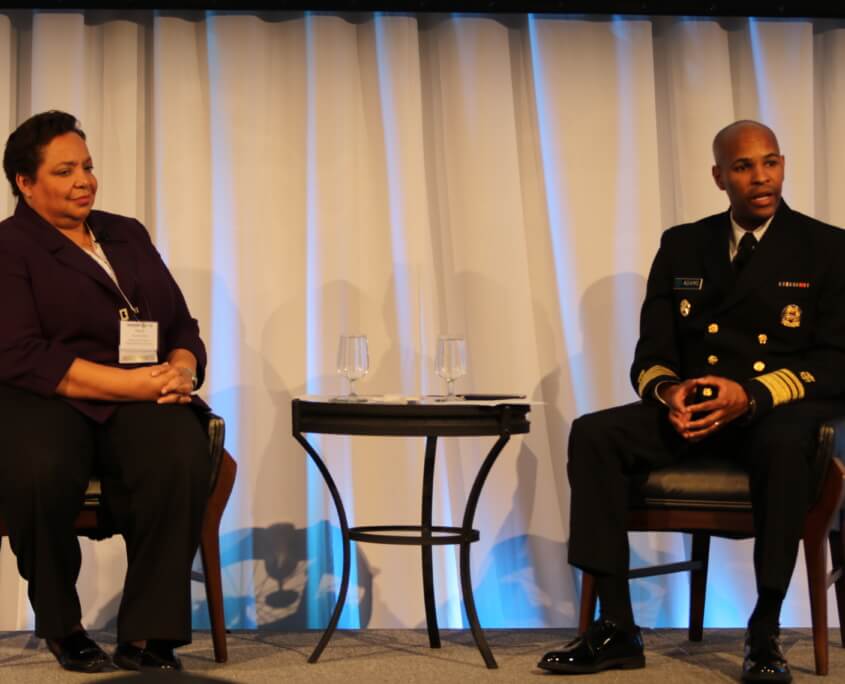
Cheryl J. Roberts, Deputy Director of Programs, Virginia Department of Medical Assistance Services, and US Surgeon General, Vice Admiral Jerome M Adams, MD, MPH
View the Surgeon General’s full remarks here
US Surgeon General, Vice Admiral Jerome Adams, MD, whose motto is “better health through better partnerships,” spoke at NASHP’s 30th annual State Health Policy Conference. It was a familiar venue for Adams, who as Indiana state health commissioner has attended NASHP conferences in the past and is a former NASHP Academy member.
As a state health commissioner, he worked to address an HIV outbreak in his state, spurred by unsafe injection practices resulting from the opioid epidemic, and worked on Indiana’s state Medicaid expansion. “I would not be where I am if it weren’t for NASHP,” he said during his opening remarks, complimenting the organization’s ability to share best practices and innovations in state health policy nationwide.
Adams, who was in Week 6 of the job when he spoke at the conference in Portland, OR, on Oct. 24, is head of the nation’s Public Health Service and serves as the nation’s doctor and its voice for communication and cultural.
What are you doing to address the opioid crisis?
I was Indiana state health commissioner during the largest HIV outbreak in the United States, with 225 cases of HIV infection in Austin, IN. This was higher than anywhere in the world (225 of the community’s 3,700 residents were infected).
It was a resource-poor community and didn’t have the capacity or cultural readiness to accept some of the remedies. Folks hammer me because they want the science, my work will always be informed by the evidence, but science is just one variable when you talk about public health policy.
We need to invite new and different people to the table. At the end of the day, we had to bring in business, faith-based, and police communities to talk about the science. I want you to keep thinking about who is not at the table, and bring them into the fold.
The Department of Health and Human Services has put out a toolkit, and the Centers for Disease Control and Prevention is working to identify opioid hotspots in communities. For example, you will be law enforcement’s best friend if you can help them focus their law enforcement and interdiction efforts, they will help you set up diversion programs so they can turn people turn toward recovery, instead of putting them in jail.
What about responding to the current increase in hepatitis C?
I think we are at a tipping point with hepatitis C, there are more people with hepatitis C than all of the other CDC-reportable diseases combined. The opioid epidemic allows us to raise discussions about hepatitis C as never before. (Hepatitis C and B have begun to increase for the first time in decades because of unsafe injection practices that transmit these bloodborne diseases.)
I would challenge you to take this opportunity, so we can ride this wave and get this into public discussions. The opioid epidemic is tragic, but it gives us an opportunity to talk about mental health, HIV and hepatitis C. Have those discussions and bring other partners to the table.
What concrete steps can the people in this audience take to support these efforts?
It’s OK to have partisan camps from a political view, but don’t let that blind you from working with the other side. It hurts my heart to see the political dissent. Try to find common goals. Think of one person who is not at the table and reach out to them and invite them to your next meeting to start that discussion.
One person alone may not seem that they’ll make a big difference, but all of us together can.
How are you reconciling all of the opposition to issues that impact public health?
I am a public health advocate, and I know we need to change some basic things. We’re focused on jobs, safety and security, and they’re ranked equally high by Republicans and Democrats. I try to reframe the public health discussion in a way that doesn’t mean me telling people that they should think the way we do.
Instead of telling teachers you should care about obesity, instead offer exercise as a way to increase test scores and fight obesity. Yes, things can seem disappointing from a public health point of view, but there are opportunities to show people how prevention can help.
I was able to get a syringe exchange program instituted in one of the most conservative communities in the country by working with police and letting them know they can reduce arrests and jail over-crowding through this program, and working with businesses to see how this program would improve the community and its reputation.
Click here to read the Surgeon General’s comments that accompanied President Trump’s comments on the opioid epidemic delivered Oct. 26, 2017.
Pictured are Cheryl J. Roberts, Deputy Director of Programs, Virginia Department of Medical Assistance Services, and Surgeon General Jerome Adams.
States Share Innovations to Tackle their Opioid Epidemics
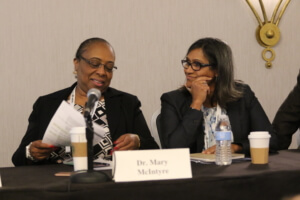
Mary McIntyre, MD, Alabama’s chief medical officer (left) and Ana Novais, executive director of Rhode Island’s Department of Health.
PORTLAND, OR – State health officials shared wide-ranging innovations in their uphill battle against the opioid epidemic that is sweeping their states at the opening day of the National Academy for State Health Policy’s (NASHP) 30th State Health Policy Conference.
Officials explained they are experimenting with new strategies that use data, new treatment approaches, and reconfigured public safety responses to illegal drug use in a race against time as overdose deaths are expected to exceed the 63,000 recorded in 2016.
Kimberly Johnson, MD, director of the US Substance Abuse and Mental Health Services Administration’s Center for Substance Abuse Treatment, ticked off the various strategies and services that are being tried out in state incubator programs that show promise in tackling this national epidemic, including providing treatment on demand, decriminalizing illegal opioid use, creating safe drug use sites and needle exchange programs, improving diagnosis of people with opioid addiction, better use of data to identify drug use patterns in communities, and addiction treatment with medications, such as methadone, which is proven to lower relapse rates.
“The number one thing states can do,” she commented following her opening remarks Monday morning, “is to address prescribing practices among providers. But it really takes all of these strategies to stop this epidemic.”
While NASHP’s three-day conference addressed a host of state public health issues, the nation’s opioid epidemic was a frequent topic at various workshops. It remains the Achilles heel, officials noted, that exposes states’ conflicting and piecemeal public health approaches even while providing opportunities for innovation.
Ana Novais, executive director of Rhode Island’s Department of Health, highlighted her state’s effort to create a dashboard that pulls data from hospitals, police, emergency rescue workers, and providers to create an overdose reporting system. Armed with data, including the latest on fentanyl deaths and locations of overdoses, the state can launch responses that involve police, rescue workers, health care providers and community leaders.
In Ohio – where one in nine of the nation’s heroin overdoses occur — the Office of Health Transformation, led by director Greg Moody, is tackling opioid over-prescribing through a health care reform called value-based pricing that rewards Medicaid managed care providers who provide high-quality care at reasonable prices.
“We wanted to knit together strategies from different domains within state government to address the opioid crisis,” he explained to more than 200 officials who attended the session. To prevent future addictions, Ohio has spearheaded a payment innovation approach to discourage over-prescribing of opioids and reward “best-practice” painkiller prescribing in its Medicaid managed care program.
One of the quality measures Ohio uses to identify “high-value” health care providers is their opioid prescribing practice. The state examines how many opioids a provider – including dentists and orthopedic specialists — prescribe and for how long. Their prescribing practices are compared with the state average. Providers who prescribe above the average amount and duration of painkillers may not get referrals and may eventually lose financial incentives.
Pennsylvania’s approach to prevent future addictions is to provide Medicaid coverage for alternative pain management treatment, such as acupuncture and yoga.
Increasing access to medically-assisted treatment for addiction, educating providers to improve opioid prescribing practices, and building coalitions between public safety and communities to get people into treatment is daunting, officials noted. Some states are proposing to add a work requirement to their Medicaid programs, similar to what exists for adults receiving Temporary Assistance to Needy Families (TANF), which concerned some policymakers. “We want to make sure that if people are working toward recovery that they are not excluded from Medicaid eligibility,” one attendee pointed out.
Another official pointed out that lawmakers in her state wondered how much funding to invest in the naloxone program if emergency personnel keep reviving the same people after multiple overdoses.
“This is a disease,” said David Kelley, MD, chief medical officer of Pennsylvania’s Department of Human Services Office of Medical Assistance Programs, “does an emergency medical technician say, ‘you’ve had angina five times already, we won’t treat you this time?’ Addiction is a disease, we need to stop thinking how many times is enough.”
“We do have to deal with the political ramifications that people still think of addiction as a personal choice,” observed Mary McIntyre, MD, chief medical officer of Alabama’s Department of Public Health.
NASHP will be publishing many of the “State Innovations and Interventions in America’s Opioid Crisis” presentations and slides, and additional blogs in the weeks ahead at oldsite.nashp.org.
CHIP and Medicaid are Essential Partners for Cross Agency Collaboration to Better Serve Children
Increasingly states are focused on the critical role social determinants play in health, and public coverage programs play a key role in this focus. For more than 20 years, the Children’s Health Insurance Program (CHIP) has worked in coordination with state Medicaid programs to serve the health needs of low-income children. States are leveraging Medicaid and CHIP funds to build additional cross agency connections that address the comprehensive care needs of children. Therefore, potential changes in Medicaid and CHIP funding could also affect collaboration efforts with other programs that serve children and families.
State officials report that cross-agency collaborations have increased administrative efficiencies and helped programs become even more effective at serving children. Congressional action however, is needed to extend federal CHIP funding beyond September 2017 and as state officials are considering what proposed changes in Medicaid financing may mean for their programs, they are also weighing how funding changes for coverage programs could affect other state agencies and public programs that are serving children.
Although there is uncertainty about future funding, states are currently continuing to support collaborative efforts in place to serve children. Massachusetts and the District of Columbia offer examples of using their CHIP and Medicaid programs to create improved coordination across multiple state agencies and programs serving youth. In Massachusetts these collaborations work at assuring low-income kids are served by social supports and in D.C., they improve the seamlessness of care provided to kids by improving the exchange of data across agencies.
Leverage Funding Opportunities to Build Partnerships
Health Services Initiatives (HSIs), authorized under Title XXI, provide states the option to use CHIP administrative funds (up to the 10 percent cap) to invest in activities that directly improve the health of children under age 19. Massachusetts, and other states, are using HSIs to leverage their CHIP funding to foster cross agency connections and as an efficient way to support state public health programs serving children’s needs. For instance, currently Massachusetts’ HSI programs include: nutritional programs through schools, smoking prevention and cessation programs, and youth violence prevention through community-based organizations. These activities are primarily funded by state appropriations to the state’s Executive Office of Health and Human Services or the Executive Office of Education with a small portion of CHIP funds used to ensure targeted low-income children are served. In Massachusetts these activities are administered through a variety of state agencies including the Department of Early Education and Care, Department of Public Health, Department of Developmental Services, Department of Elementary and Secondary Education, and Department of Children and Families.
Through the implementation of HSIs, Massachusetts has successfully braided different funding streams to best serve the health needs of children. HSIs have enabled Massachusetts to build interagency connections to support a variety of programs that address an array of children’s health needs by effectively using available state and federal resources. If federal CHIP funding is not extended Massachusetts would lose a crucial funding source that is key to the operation of these initiatives.
Partner to Overcome Coordination Barriers
In the District, the Department of Health Care Finance (DHCF), which administers D.C.’s Medicaid expansion CHIP program, identified a lack of data sharing and collaboration across agencies as a barrier to accurately identifying children with unmet health needs. To address this issue, a cross-agency data sharing partnership with DHCF, the Department of Health (DOH), and D.C. Public Schools (DCPS) was formed. The partnership aims to address the issue of duplicative documentation efforts by the three agencies serving the same child and family population, as well as to provide a more accurate understanding of where there may be a lack of coverage of basic healthcare needs for children. Each of these agencies have different health data mandates including: maintenance of health forms (DCPS), immunization compliance data (DOH), Medicaid status and service utilization (DHCF), and managed care organization assignment (DHCF). In order to share their respective data, the three agencies developed a Memorandum of Agreement. Through this agreement the agencies worked together to effectively address often cited barriers to data sharing, such as the Family Educational Right and Privacy Act (FERPA) and Health Insurance Portability and Accountability Act (HIPAA). By convening stakeholders early, identifying each other’s institutional requirements, and gaining approval from all agencies the partners were able to work around these barriers.
As a result of their collaboration, these three D.C. agencies are able to promote health services outreach and target health resources to the appropriate schools. Sharing DCPS school enrollment data, DOH immunization data, and DHCF Medicaid enrollment data, the agencies can better identify which schools to target with needed services such as oral health care or health education efforts. By building these connections across agencies, D.C. has been able to better serve the health needs of children by increasing efficiencies in coverage and identifying gaps in service utilization.
Conclusion
These examples illustrate two distinct ways states are leveraging their CHIP and Medicaid programs to coordinate across agencies and highlight the important roll partnerships play in providing comprehensive care to children. Given the current uncertainty of federal CHIP funds after September 2017 and state officials’ concerns about the potential ripple effects of proposed funding changes on multiple agencies and programs serving families, it is particularly important to recognize the cross agency structures states have developed to serve vulnerable populations.
To learn more about HSIs: https://www.medicaid.gov/federal-policy-guidance/downloads/faq11217.pdf
 For individuals living with complex, often chronic conditions, and their families, palliative care can provide relief from symptoms, improve satisfaction and outcomes, and help address critical mental and spiritual needs during difficult times. Now more than ever, there is growing recognition of the importance of palliative care services for individuals with serious illness, such as advance care planning, pain and symptom management, care coordination, and team-based, multi-disciplinary support. These services can help patients and families cope with the symptoms and stressors of disease, better anticipate and avoid crises, and reduce unnecessary and/or unwanted care. While this model is grounded in evidence that demonstrates improved quality of life, better outcomes, and reduced cost for patients, only a fraction of individuals who could benefit from palliative care receive it.
































































